Video Wall vs Projector for Corporate AV Systems: Which Technology Is More Scalable?
As corporate AV systems continue to expand across multi-site enterprises, global headquarters, and distributed facilities in 2026, scalability has emerged as the defining factor in technology selection decisions. The led wall vs projector debate is no longer simply about image quality or initial costs—it's fundamentally about which display technology can grow with your organization while maintaining performance consistency, operational efficiency, and budget predictability.
The importance of choosing the best between led wall vs projector for scalable corporate AV deployments cannot be overstated. Organizations investing in AV infrastructure today must consider how their display technology choices will accommodate future expansions, support emerging collaboration requirements, integrate with evolving building systems, and adapt to changing workplace strategies. The wrong decision can result in stranded investments, incompatible systems, excessive retrofit costs, and technology obsolescence within just 3-5 years.
For AV system integrators, corporate IT directors, and facility planners, understanding scalability factors—including physical expansion capabilities, resolution upgrades, infrastructure reusability, standardization potential, maintenance scalability, and total cost of ownership across multi-site deployments—is essential for making informed technology recommendations. This comprehensive guide examines the video wall vs projector decision through the lens of enterprise scalability, providing actionable insights for organizations planning AV systems that must serve evolving needs over 10-15 year investment horizons.
Direct answer: Video walls offer superior physical scalability through modular expansion, better technology upgrade paths, and more standardized deployment models compared to projectors, making them the more scalable solution for corporate AV systems requiring consistent performance across multiple locations and future expansion.
Key Takeaways
Video walls provide modular scalability allowing incremental expansion without complete system replacement
Projector systems offer deployment scalability enabling faster rollout across multiple sites due to lower per-unit costs
Standardization is easier with video walls due to consistent performance regardless of room characteristics
Resolution scalability favors video walls with panel-based upgrades versus complete projector replacement
Infrastructure scalability differs significantly—video walls require robust wall structures while projectors need ceiling support and throw distance
AI-powered AV design tools are transforming how organizations plan scalable corporate AV deployments
Total cost of ownership over 10+ years often favors video walls for high-usage installations despite higher initial investment
Maintenance scalability strongly favors LED video walls with 100,000+ hour lifespans and no consumable parts
The most scalable corporate AV strategy often involves both technologies deployed strategically based on space requirements
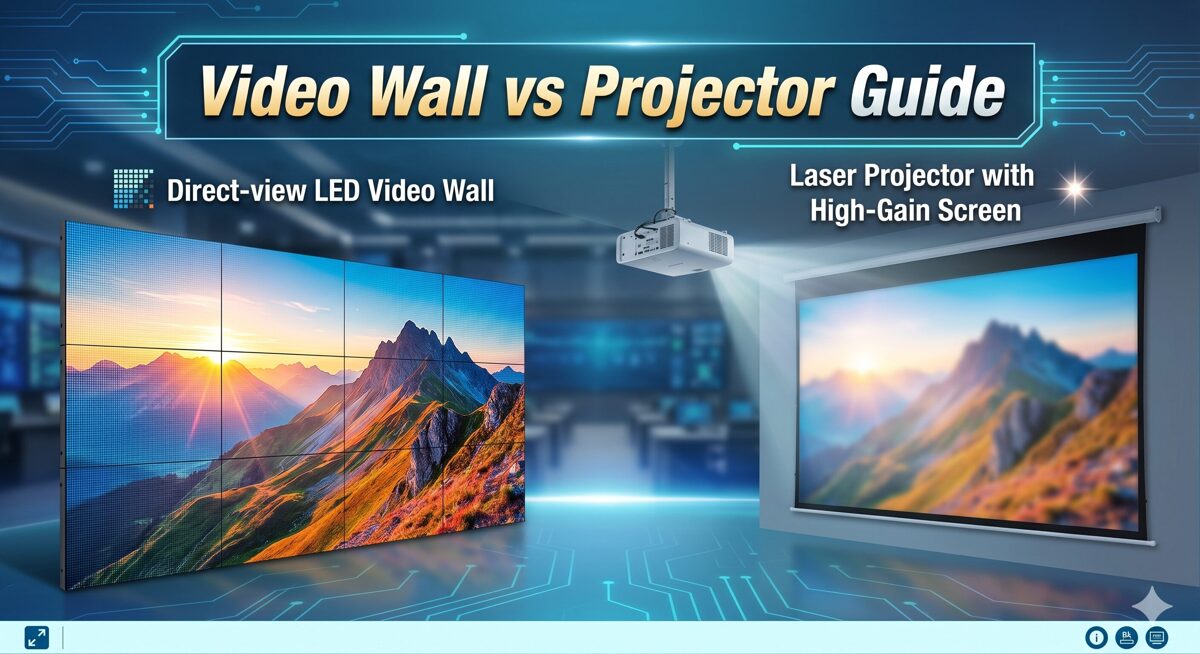
What Is a Video Wall in Corporate AV?
A video wall in corporate AV systems is a multi-panel display solution comprising multiple LED modules or LCD screens arranged in a grid configuration to create a seamless, large-format visual display surface. Unlike consumer displays, corporate video walls are engineered for commercial reliability, extended operational hours (24/7 capability), sophisticated content management, and enterprise integration with building systems and IT infrastructure.
Video Wall Technologies for Corporate Environments
LED Video Walls
LED video wall technology represents the premium tier for scalable corporate AV deployments:
Direct-view LED panels with pixel pitches ranging from 0.6mm to 2.5mm
Self-emissive technology delivering 600-2500 nits brightness
Modular cabinet design (typically 500mm × 500mm or 600mm × 337.5mm)
Seamless appearance with no visible bezels between modules
100,000-150,000 hour lifespans minimizing replacement cycles
HDR capability and wide color gamuts (90-100% DCI-P3)
LCD Video Walls
LCD tiled video walls provide cost-effective scalability:
Commercial LCD panels (46"-55" diagonal) with ultra-narrow bezels (0.9mm-1.8mm)
Brightness levels of 500-700 nits suitable for indoor environments
50,000-70,000 hour operational lifespans
4K and 8K resolution options for detailed content
Established supply chains supporting rapid deployment
Scalability Characteristics of Video Walls
Video walls offer multiple scalability dimensions:
Physical expansion through additional panel installation
Resolution upgrades by replacing individual panels with higher-density options
Content zone flexibility adapting to changing display requirements
Backward compatibility with existing mounting structures
Standardized interfaces (HDMI, DisplayPort, SDI) ensuring long-term connectivity
What Is a Projector in Corporate AV Systems?
A projector in corporate AV systems is an optical display device that uses lamp-based, laser, or LED light sources to project images onto a screen surface or treated wall. Corporate-grade projectors differ from consumer models through higher brightness specifications (5,000-30,000+ lumens), advanced lens systems, enterprise management features, and extended warranty programs.
Projector Categories for Corporate Deployments
Laser Projectors
Laser projection technology dominates corporate installations in 2026:
Solid-state laser light sources delivering 20,000-30,000 hour lifespans
Brightness range from 5,000 to 30,000+ lumens
Instant-on/off capability eliminating warmup periods
Color consistency maintained throughout operational lifetime
Reduced maintenance with no lamp replacements
Lower total cost of ownership compared to lamp-based alternatives
Ultra-Short-Throw Projectors
UST projectors address space-constrained environments:
Throw ratios of 0.19:1 to 0.35:1 enabling close placement
100-150" images from 6-20 inches projection distance
Interactive capabilities through touch overlays or IR sensors
Shadow-free presentations improving meeting dynamics
Enterprise Projection Systems
High-end projection solutions for large venues:
3-chip DLP technology delivering superior color accuracy
Interchangeable lenses providing installation flexibility
Edge blending for multi-projector arrays
Motorized lens shift and zoom supporting precision alignment
Network management through PJLink and proprietary protocols
Scalability Characteristics of Projectors
Projectors offer distinct scalability advantages:
Deployment speed enabling rapid multi-site rollout
Lower per-unit investment supporting wider technology distribution
Installation flexibility adapting to diverse space configurations
Portable options for temporary and mobile deployments
Technology refresh cycles typically 5-7 years for budget planning
Why Scalability Matters in Corporate AV Systems
Scalability in corporate AV infrastructure extends far beyond simple physical expansion—it encompasses operational flexibility, financial sustainability, and long-term strategic alignment with organizational growth.
Business Growth and Geographic Expansion
Organizations experience AV scalability needs through:
Mergers and acquisitions requiring technology standardization across acquired facilities
New office openings demanding rapid AV deployment with consistent user experience
Global expansion necessitating reliable equipment sourcing in multiple regions
Organizational restructuring changing space utilization patterns and technology requirements
Technology Evolution and Upgrade Paths
Scalable AV systems must accommodate:
Resolution improvements as 4K, 8K, and future standards become prevalent
Content format evolution supporting HDR, high frame rates, and expanded color spaces
Integration requirements with emerging collaboration platforms and workplace technologies
Connectivity standards transitioning from HDMI 2.0 to HDMI 2.1 and beyond
Financial and Operational Considerations
Scalability impacts:
Capital expenditure planning for multi-year infrastructure investments
Operational expense predictability through standardized maintenance and support contracts
Resource allocation for AV support staff and technical training
Total cost of ownership optimization across entire facility portfolios
Standardization and User Experience
Consistent technology deployment provides:
Reduced training requirements as employees move between locations
Simplified troubleshooting through standardized equipment and procedures
Improved user satisfaction from predictable performance across all spaces
Vendor relationship leverage through volume purchasing and consolidated support
Video Wall vs Projector: Feature-by-Feature Scalability Comparison
Understanding how video walls and projectors compare across key scalability dimensions is essential for strategic AV planning.
Scalability Factor | Video Wall | Projector | Advantage |
Physical Expansion | Modular panel addition (high) | Limited to projector replacement (low) | Video Wall |
Multi-Site Deployment Speed | Slower (complex installation) | Faster (standardized mounting) | Projector |
Resolution Upgrade Path | Panel replacement (moderate cost) | Complete unit replacement (moderate-high cost) | Video Wall |
Infrastructure Reusability | Mounting frames reusable (high) | Ceiling mounts reusable (moderate) | Video Wall |
Content System Scalability | Video processors scale easily (high) | Limited by projector inputs (low) | Video Wall |
Per-Location Investment | High ($50,000-$300,000+) | Low-Moderate ($15,000-$60,000) | Projector |
Standardization Ease | High (consistent performance) | Moderate (lighting-dependent) | Video Wall |
Maintenance Scalability | Low frequency (high scalability) | Moderate frequency (moderate scalability) | Video Wall |
Energy Cost Scaling | Moderate ($800-$4,000/year) | Low-Moderate ($300-$1,500/year) | Projector |
Technology Refresh Cycle | 10-15 years | 5-7 years | Video Wall |
Physical Expansion Scalability
Video walls excel in modular expansion:
Panel addition increases display area without complete system replacement
Mounting structures accommodate future expansion through design foresight
Video processors support additional panels through output expansion
Minimal disruption to existing displays during expansion projects
Example: A 3×3 LCD video wall can expand to 4×4 or 3×4 configurations by adding panels, with total expansion cost typically 30-40% of original installation.
Projectors require complete replacement for size increases:
Larger screen sizes necessitate higher lumen projectors
No incremental expansion possible within existing equipment
Complete reinstallation required for significant size changes
Multi-Site Deployment Scalability
Projectors offer advantages for rapid multi-site rollout:
Lower per-unit costs ($8,000-$30,000) enable wider deployment budgets
Faster installation (1-2 days per room) accelerates project completion
Simplified logistics with smaller equipment and standard shipping
Established vendor networks supporting global deployments
Video walls require more deployment planning:
Higher per-site investment limits simultaneous installations
Longer installation timelines (3-7 days per room) extend project schedules
Structural assessments and load calculations add planning complexity
Specialized installation teams may limit contractor availability
Resolution and Technology Upgrade Scalability
Video walls provide flexible upgrade paths:
Individual panel replacement enables phased upgrades rather than complete replacement
Mixed resolution configurations support budget-conscious improvements
Mounting infrastructure reuse reduces upgrade costs by 40-60%
Backward compatibility with existing processors in many cases
Projectors require full unit replacement for resolution upgrades:
1080p to 4K migration necessitates new projector purchase
No modular upgrade options for light sources or optical systems
Mounting hardware reusability provides limited cost savings
Infrastructure Scalability
Video wall infrastructure requirements:
Structural support must accommodate full weight at initial installation
Power distribution designed for maximum configuration from project start
Cooling systems sized for full deployment or expandable with planning
Control room equipment scales through modular expansion
Projector infrastructure scales more easily:
Ceiling mounts standardized across similar spaces
Power requirements consistent per device
Cooling typically adequate with standard HVAC
Control systems add devices incrementally
Video Wall vs Projector: Best Use Cases
Understanding where each technology excels enables optimal deployment strategies in scalable corporate AV systems.
Video Wall Optimal Deployments
Corporate Command Centers and NOCs
Video walls are ideal for 24/7 operations:
Mission-critical visualization requiring zero downtime
Multi-source display showing dozens of data feeds simultaneously
High ambient light from continuous workspace illumination
Operator positioning requiring wide viewing angles
Scalability requirement: Content complexity increases as operations expand
Executive Boardrooms
Premium environments demand video wall quality:
Client-facing spaces requiring professional aesthetics
Hybrid meeting headquarters with frequent video conferencing
Uncontrolled lighting from floor-to-ceiling windows
Longevity requirement aligning with boardroom permanence
Scalability requirement: Technology refresh must match executive expectations
Corporate Lobbies and Reception Areas
Public-facing displays benefit from video wall advantages:
Branding and wayfinding requiring 24/7 operation
High ambient light from natural daylight
Viewing distance variability from foot traffic patterns
Content flexibility for multiple communication purposes
Scalability requirement: Content zones expand with organizational complexity
Multi-Purpose Conference Centers
Large collaboration spaces leverage video wall benefits:
All-hands meetings with 100+ in-room participants
Town halls requiring clear visibility from all seating areas
Hybrid events demanding professional visual quality
Scalability requirement: Content sources increase with collaboration tools
Projector Optimal Deployments
Standard Conference Rooms
Projectors serve conventional meeting spaces effectively:
Light-controlled environments with blinds or low windows
Moderate usage (5-15 hours/week)
Budget constraints limiting per-room investment
Scalability requirement: Numerous rooms requiring cost-effective solutions
Training Facilities
Educational environments benefit from projection advantages:
Large screen sizes (150"-200"+) at reasonable costs
Intermittent usage patterns (classes vs. continuous operation)
Existing infrastructure supporting traditional projection
Scalability requirement: Multiple training rooms deployed simultaneously
Auditoriums and Large Venues
High-ceiling spaces suit projection technology:
Extra-large displays (300"+) required for distant viewers
Specialized viewing environments with dedicated lighting control
Occasional usage for corporate events and gatherings
Scalability requirement: Limited number of specialized venues per facility
Temporary and Mobile Installations
Portable displays favor projector solutions:
Trade show booths requiring transportable equipment
Client presentations at external locations
Temporary office spaces during renovations
Scalability requirement: Shared equipment across multiple use cases
Video Wall vs Projector: Pros and Cons
Video Wall Advantages for Scalability
Operational Scalability:
Long operational lifespans (100,000+ hours) minimize replacement frequency across large installations
Minimal maintenance reduces support staff scaling as deployments grow
Consistent performance eliminates site-specific optimization during multi-location rollout
24/7 capability supports diverse usage patterns without accelerated degradation
Technical Scalability:
Modular expansion accommodates growing display requirements without complete replacement
Resolution flexibility through panel replacement rather than system overhaul
Content processing scales through additional outputs and processors
Future-proof connectivity with multiple input standards and expandable options
Financial Scalability:
Predictable costs over 10-15 year lifecycles simplify long-term budgeting
Reduced consumable expenses (no lamps or filters) lower operational costs as installations grow
Volume purchasing leverage for multi-site deployments reducing per-panel costs by 15-30%
Infrastructure reusability during upgrades minimizes total replacement costs
Video Wall Disadvantages for Scalability
Initial Investment Barriers:
High per-site costs ($50,000-$300,000+) limit simultaneous multi-site deployment
Capital expenditure concentration may strain annual budgets
Longer ROI timelines (3-5 years) challenging for fast-scaling organizations
Deployment Complexity:
Extended installation timelines (3-7 days) slow rapid expansion projects
Structural requirements vary by facility, complicating standardization
Specialized installation expertise limits contractor pool in some regions
Project planning complexity increases deployment overhead
Physical Constraints:
Wall load limitations in older buildings may prevent installation
Relocation challenges make office reconfigurations expensive
Heat dissipation requirements necessitate HVAC considerations
Projector Advantages for Scalability
Deployment Scalability:
Lower per-unit costs ($8,000-$30,000) enable rapid multi-room deployment
Faster installation (1-2 days) accelerates expansion timelines
Standardized installation procedures simplify contractor management
Global availability ensures equipment sourcing in international markets
Financial Flexibility:
Lower initial investment allows phased deployment matching budget cycles
Operational expense categorization possible for some laser models (leasing)
Predictable refresh cycles (5-7 years) align with IT budgeting practices
Physical Flexibility:
Portable models support multi-space usage and temporary needs
Ceiling mounting accommodates office reconfigurations more easily
Minimal structural impact simplifies facility approvals
Projector Disadvantages for Scalability
Maintenance Scalability Challenges:
Filter cleaning requirements increase support staff workload proportionally with deployment size
Lamp replacements (for non-laser models) create inventory management complexity
Service call frequency scales directly with number of installed units
Performance degradation over time necessitates site-by-site optimization
Performance Inconsistency:
Lighting variations across different facilities require site-specific specifications
Screen quality differences affect user experience consistency
Ambient light changes (seasonal, daily) impact image quality unpredictably
Standardization challenges complicate enterprise-wide deployments
Technology Refresh Complexity:
Shorter replacement cycles (5-7 years) increase administrative overhead for large deployments
No incremental upgrade paths require complete replacement during technology transitions
Disposal logistics for numerous units across multiple sites
How AI-Powered AV Design Software Helps Scale Corporate AV Systems
Artificial intelligence is revolutionizing how AV integrators and corporate IT teams plan and execute scalable AV deployments in 2026.
AI-Driven Room Analysis and Optimization
Computer vision and machine learning enable:
Automated Space Assessment
Room scanning using LiDAR and photogrammetry capturing dimensions, lighting, and architectural features
Viewing angle analysis calculating optimal display placement for seating configurations
Ambient light mapping throughout daily cycles informing technology selection
Acoustic modeling predicting audio system requirements
Intelligent Technology Recommendations
AI algorithms analyzing room characteristics to recommend video wall vs projector based on scalability factors
Performance prediction showing expected image quality under actual conditions
Cost-benefit analysis comparing technologies across 10-15 year lifecycles
Standardization optimization identifying common specifications across multiple spaces
Predictive Scaling and Capacity Planning
Machine learning models forecast:
Usage Pattern Analysis
Historical data from existing installations predicting future requirements
Meeting frequency and duration analysis informing technology selection
Content type distribution guiding resolution and display size specifications
Concurrent usage patterns across facilities optimizing deployment schedules
Growth Modeling
Space utilization trends predicting expansion needs 3-5 years ahead
Organizational growth correlation with AV infrastructure requirements
Technology refresh scheduling aligned with business cycles and budgets
Scenario planning for mergers, acquisitions, and reorganizations
Automated Design and Documentation
AI-powered tools streamline:
Intelligent CAD Integration
Automated drawing generation from room scans and specifications
Equipment placement optimization considering mounting constraints and cable routing
Bill of materials creation with real-time pricing from distributor databases
Installation instruction generation customized for contractor skill levels
Configuration Management
Version control for multi-site deployment standards
Deviation tracking identifying site-specific modifications and their rationale
Documentation automation maintaining as-built drawings and equipment databases
Compliance verification ensuring specifications meet corporate standards
Digital Twin Technology for AV Systems
Virtual replicas of physical AV installations enable:
Pre-Deployment Validation
Virtual commissioning testing system integration before physical installation
User experience simulation showing view from different seat positions
Content visualization previewing actual presentations on proposed displays
Troubleshooting scenarios identifying potential issues during design phase
Lifecycle Management
Real-time monitoring of deployed systems through IoT integration
Predictive maintenance alerting to component degradation before failures
Performance optimization suggesting configuration adjustments based on usage patterns
Upgrade planning showing expansion options and costs in virtual environment
AI-Powered Vendor Selection and Procurement
Intelligent procurement systems optimize:
Product Matching
Requirement analysis matching specifications to available products
Performance benchmarking comparing manufacturer claims to field data
Compatibility verification ensuring interoperability across system components
Alternative suggestion when specified products are unavailable or discontinued
Cost Optimization
Real-time pricing aggregation from multiple distributors
Volume discount modeling for multi-site purchases
Total cost of ownership calculation including energy, maintenance, and refresh costs
Budget allocation optimization across multiple projects and fiscal years
Collaborative AI Platforms
Cloud-based AI tools facilitate:
Multi-Stakeholder Collaboration
Virtual design reviews with real-time visualization for remote teams
Automated meeting notes and decision tracking during planning sessions
Stakeholder feedback integration into design iterations
Approval workflow management with audit trails
Knowledge Management
Lessons learned capture from completed projects informing future designs
Best practice identification through analysis of successful deployments
Failure pattern recognition preventing recurring issues
Expertise amplification making senior designer knowledge accessible to junior staff
Video Wall vs Projector: Which Technology Is More Scalable?
The answer to which technology is more scalable depends fundamentally on how your organization defines scalability and what growth patterns you anticipate.
Video Walls: Superior Technical Scalability
Video walls excel in scalability dimensions critical for high-performance deployments:
Physical and Technical Expansion
Video walls offer unmatched modular scalability for growing display requirements. Organizations can add panels to existing arrays without replacing infrastructure, enabling phased expansion aligned with budget cycles and business needs. A 4×4 video wall can expand to 6×4 or 4×6 configurations with 30-40% of original installation cost, preserving initial investment while accommodating increased content complexity or viewing area requirements.
Resolution upgrades through panel replacement rather than complete system replacement provide technology future-proofing. As pixel density improves and prices decrease, organizations can upgrade sections of video walls to higher resolution panels, creating mixed-resolution arrays during transition periods or implementing premium zones with enhanced detail while maintaining budget constraints.
Standardization and Consistency
Video walls deliver consistent performance across diverse environments, enabling true enterprise standardization. Unlike projectors where image quality varies with ambient lighting, screen quality, and installation precision, video walls perform identically in windowed boardrooms and internal conference rooms. This performance consistency dramatically reduces site-specific engineering, user training variation, and support complexity as deployments scale to dozens or hundreds of locations.
Maintenance scalability strongly favors video walls with 100,000-150,000 hour lifespans and zero consumables. As installations grow from 10 to 100+ locations, the maintenance burden for projectors grows proportionally (filters, lamps, service calls), while video wall maintenance remains minimal regardless of deployment size. This operational scalability becomes increasingly valuable as AV infrastructure expands.
Long-Term Financial Scalability
Total cost of ownership over 10-15 years and multiple sites often favors video walls despite higher initial investment. With no lamp replacements ($800-$2,000 per projector every 2,000-5,000 hours for non-laser models), no filter replacements ($100-$300 annually), and longer replacement cycles (15 years vs. 5-7 years), the cumulative costs across 50-100 installations can favor video walls by significant margins.
Budget predictability improves with video walls as organizations scale. Fixed costs and known replacement timelines simplify multi-year capital planning, while projector deployments face variability in maintenance costs, unexpected failures, and performance degradation requiring premature replacement.
Projectors: Superior Deployment Scalability
Projectors excel in scalability dimensions emphasizing rapid expansion and financial flexibility:
Multi-Site Deployment Speed
Projectors enable faster rollout across numerous locations through lower per-site investment ($15,000-$60,000 vs. $50,000-$300,000+), shorter installation timelines (1-2 days vs. 3-7 days), and simplified logistics. Organizations expanding rapidly through acquisitions or geographic growth can deploy projectors to 20-30 locations in the time and budget required for 5-10 video wall installations.
Capital expenditure distribution favors projectors when budgets must spread across many spaces rather than concentrating in premium locations. A $500,000 annual AV budget can deploy projectors to 25-30 conference rooms versus video walls to 2-5 rooms, extending technology benefits to more employees and supporting broader collaboration across organizations.
Physical and Architectural Flexibility
Projectors accommodate diverse space types without structural modifications. Older buildings with load limitations, temporary facilities, mobile installations, and reconfigurable spaces favor projection solutions that mount to ceilings or tables rather than requiring reinforced walls. This installation flexibility accelerates deployment timelines by eliminating engineering assessments, structural reinforcement, and facility approvals that video walls often require.
Relocation capability supports organizations experiencing frequent office reconfigurations. Projectors can move to new spaces with modest reinstallation costs, while video walls effectively remain permanently in original locations. For organizations with uncertain long-term space strategies, this flexibility preserves technology investments during reorganizations.
Technology Refresh Alignment
Projector replacement cycles (5-7 years) align with IT refresh schedules, creating administrative efficiency and budget consistency. Organizations accustomed to 5-year computer replacement can bundle AV equipment into existing refresh programs, leveraging established procurement processes, vendor relationships, and disposal procedures.
Hybrid Scalability Strategy: The Optimal Approach
The most scalable corporate AV strategy typically involves both technologies deployed according to space requirements and organizational priorities:
Tiered Deployment Model
Tier 1 - Premium Spaces (Video Walls):
Executive boardrooms (10-15% of spaces)
Main conference centers (5-10% of spaces)
Command centers and NOCs (1-2% of spaces)
Corporate lobbies and reception areas (2-5% of spaces)
Tier 2 - Standard Spaces (Projectors):
Departmental conference rooms (50-60% of spaces)
Training facilities (10-15% of spaces)
Multi-purpose rooms (5-10% of spaces)
Tier 3 - Huddle/Small Spaces (Flat Panels or Small Projectors):
Huddle rooms (15-20% of spaces)
Private offices (occasional deployment)
This tiered approach optimizes capital allocation, user experience, and operational efficiency while providing scalability at each tier through appropriate technology.
Standardization Within Tiers
Critical success factor: Standardize specifications within each tier rather than across entire portfolio. All executive boardrooms should deploy identical video wall specifications, while all standard conference rooms use consistent projector models. This tier-specific standardization captures scalability benefits (volume pricing, simplified support, training consistency) while optimizing technology to space requirements.
Frequently Asked Questions
Can video walls scale to accommodate future resolution increases like 8K?
Yes, video walls offer superior resolution scalability compared to projectors. For LED video walls, resolution increases through panel replacement with smaller pixel pitch modules while reusing mounting structures, processors, and infrastructure. A 1.5mm pitch video wall can upgrade to 1.0mm or 0.9mm modules, effectively increasing resolution from approximately 2.5K to 4K+ at the same physical size. This modular upgrade approach typically costs 40-60% less than complete replacement and preserves infrastructure investment.
For LCD video walls, resolution upgrades involve replacing panels with 4K or 8K models, which is simpler and less expensive than video wall processor upgrades often required for substantial resolution changes. Mounting frames, power distribution, and control systems remain compatible across panel generations.
Projectors require complete unit replacement for resolution upgrades (1080p to 4K to 8K), with no incremental upgrade path. While mounting hardware is reusable, all optical components, light sources, and processing electronics must be replaced, making resolution upgrades effectively full system replacements.
How does maintenance complexity scale with 50+ video walls vs 50+ projectors?
Maintenance scalability strongly favors video walls at enterprise scale. With 50 video wall installations, annual maintenance requirements include:
Periodic cleaning (2-4 times/year): Professional service or in-house staff with minimal training
Rare component failures (approximately 1-2% annual failure rate): Individual module replacement (typically 2-4 incidents across 50 sites)
No consumable replacements (lamps, filters)
Estimated annual maintenance burden: 200-400 staff hours across all locations
With 50 projector installations, annual maintenance requirements include:
Filter cleaning/replacement (quarterly): 200 service events annually
Lamp replacements (laser models eliminate this, lamp-based require 10-25 replacements annually)
Service calls for image quality issues, overheating, alignment: 15-30 incidents annually
Lens cleaning and optical adjustments: 50-100 service events annually
Estimated annual maintenance burden: 800-1,500 staff hours across all locations
For organizations with in-house AV staff, this translates to 1-2 full-time positions for video wall maintenance versus 3-5 positions for projector maintenance at 50-installation scale. For organizations using external service contracts, annual costs run $3,000-$10,000 per site for video walls versus $5,000-$15,000 per site for projectors including consumables and labor.
Which technology scales better for global deployments across different countries?
Global deployment scalability depends on regional factors, with different advantages for each technology:
Video Walls scale better for consistent global standards:
Performance uniformity regardless of local electrical standards or climate conditions
Product availability improving globally as LED manufacturing expands
Longer refresh cycles reduce international logistics frequency
Higher value shipments justify white-glove logistics and customs clearance
However, challenges include:
Limited installer availability in emerging markets
Import duties and taxes on high-value equipment (typically 10-30% in many countries)
Warranty support variations across regions
Projectors scale better for rapid international expansion:
Global product availability through established distribution networks
More local installation contractors with projection expertise
Lower value shipments reducing customs complexity and costs
Standardized specifications easier to source across different markets
However, challenges include:
Performance variations due to screen availability and quality differences across regions
More frequent shipping for maintenance parts (lamps, filters)
Local electrical standards affecting power requirements and UPS compatibility
Optimal approach: Standardize on video walls for headquarters and flagship offices in major markets, while using projectors for secondary locations and markets with limited AV infrastructure. This hybrid strategy balances consistent user experience with deployment practicality.
How do video walls and projectors compare for scalability in retrofit vs new construction?
Retrofit scenarios favor projectors for deployment scalability:
Projector advantages in existing buildings:
No structural assessment required for load-bearing capacity
Existing ceiling infrastructure often accommodates projector mounting
Faster installation minimizing space disruption
Lower electrical requirements fitting within existing circuit capacity
No HVAC modifications for heat dissipation
Video wall challenges in retrofit projects:
Load calculations may reveal wall reinforcement needs (adding $5,000-$25,000 per installation)
Electrical upgrades for dedicated circuits (adding $2,000-$10,000)
HVAC assessments for adequate cooling (potentially requiring ductwork modifications)
Extended project timelines due to engineering requirements
New construction strongly favors video walls for long-term scalability:
Video wall advantages in new buildings:
Structural design incorporates load requirements from project inception
Electrical infrastructure designed for future expansion (higher capacity circuits)
HVAC planning accounts for display heat loads
AV infrastructure (conduit, cable trays) optimized for video wall installations
No retrofit constraints enabling optimal mounting and cable routing
Best practice: For organizations planning major renovations or new construction, design AV infrastructure to support future video wall installation even if initial budget dictates projector deployment. This forward planning (adding $5,000-$15,000 to initial construction) preserves video wall scalability without expensive retrofits when budgets allow upgrades.
What role do AI and automation play in scaling AV management across large organizations?
AI-powered AV management is transforming scalability at enterprise level, with dramatic impacts on operational efficiency:
Automated Monitoring and Diagnostics
AI systems continuously monitor all displays across corporate portfolios:
Anomaly detection identifying performance degradation before user complaints
Predictive maintenance scheduling service based on actual component health rather than fixed intervals
Root cause analysis diagnosing issues from remote monitoring data
Automated ticketing creating service requests with detailed diagnostic information
Impact on scalability: Organizations with 100+ displays report 40-60% reduction in service calls and 50-70% faster resolution times through AI diagnostics, effectively allowing one technician to support installations that previously required three technicians.
Intelligent Content Management
AI-driven systems optimize content delivery at scale:
Automated content distribution to appropriate displays based on space type and scheduling
Dynamic layout optimization adjusting window sizes and positions for content types
Bandwidth optimization reducing network load through intelligent caching and compression
Usage analytics identifying underutilized displays for resource reallocation
Impact on scalability: Content management workload remains nearly constant as displays scale from 20 to 200+, rather than growing proportionally with traditional systems.
Energy Management
AI algorithms reduce operational costs at scale:
Occupancy-based dimming or shutdown saving energy during unoccupied periods
Ambient light adaptation reducing brightness when adequate while maintaining image quality
Predictive scheduling pre-warming displays before scheduled meetings while powering down during predictable idle periods
Impact on scalability: Organizations report 30-50% energy reduction across display portfolios, with savings increasing as deployment scales (more usage data improves AI models).
Can projector systems achieve the same standardization as video walls for enterprise deployments?
Standardization is more challenging with projectors due to environmental dependencies, but achievable with proper planning:
Video wall standardization advantages:
Performance consistency regardless of room characteristics
Identical user experience across all installations
Simplified specifications (screen size, resolution) without environmental variables
Predictable installation requirements and timelines
Projector standardization challenges:
Ambient light variations require different lumen specifications for different spaces
Throw distance variations necessitate different lens or projector models
Screen type and quality impact image quality and user experience
Ceiling height differences affect mounting approaches and image geometry
Achieving projector standardization:
Space Classification System: Categorize spaces by characteristics (ceiling height, ambient light, room size) and develop standard specifications for each category (e.g., "Type A: 10,000 lumen laser, UST" for boardrooms, "Type B: 6,000 lumen laser, standard throw** for standard conference rooms)
Rigorous Ambient Light Measurement: Conduct light audits across sample spaces, establishing maximum acceptable light levels for each projector specification. Implement standardized window treatments to achieve consistent conditions.
Standardized Screen Specifications: Specify identical screen models, mounting heights, and viewing distances across similar spaces, ensuring consistent image quality regardless of projector slight variations**.
Comprehensive Documentation: Create installation guidelines with detailed measurements, alignment procedures, and calibration standards ensuring consistent results across different installation teams.
With these approaches, projector standardization can achieve 80-90% consistency compared to video walls' near-perfect standardization, making it viable for large deployments where cost considerations outweigh perfect uniformity.
How does the total cost of ownership compare when scaling to 100+ installations?
Total cost of ownership at 100-installation scale demonstrates significant cost dynamics favoring different technologies based on usage intensity:
High-Usage Scenario (20+ hours/week per display)
Video Wall TCO (10-year horizon, 100 installations):
Initial investment: $5,000,000-$20,000,000 (LED) or $3,500,000-$12,000,000 (LCD)
Energy costs (10 years): $800,000-$4,000,000
Maintenance/service: $2,000,000-$6,000,000
Refreshes/upgrades: $1,000,000-$3,000,000 (partial)
Total 10-year TCO: $8,800,000-$33,000,000
Average per installation: $88,000-$330,000
Projector TCO (10-year horizon, 100 installations):
Initial investment: $1,500,000-$5,000,000
Energy costs (10 years): $300,000-$1,500,000
Maintenance/consumables: $4,000,000-$10,000,000 (filters, lamps, service)
Complete replacements (1.5 refresh cycles): $2,000,000-$7,500,000
Total 10-year TCO: $7,800,000-$24,000,000
Average per installation: $78,000-$240,000
Cost advantage: Projectors save $1,000,000-$9,000,000 at 100-installation scale over 10 years in high-usage scenarios, though gap narrows significantly compared to smaller deployments due to multiple projector refresh cycles.
Moderate-Usage Scenario (10-15 hours/week per display)
Similar TCO analysis shows video walls achieving near-parity with projectors at 100+ installations when laser projectors are specified, as reduced lamp replacement costs bring projector maintenance into video wall ranges.
Mission-Critical Scenario (24/7 operation)
For command centers and NOCs requiring continuous operation, video wall TCO becomes 40-60% lower than projectors due to accelerated projector degradation, increased maintenance frequency, and more frequent replacements (2-3 refresh cycles vs. 0-1 for video walls).
Conclusion
The question of whether video walls or projectors are more scalable for corporate AV systems cannot be answered with a simple declaration—scalability manifests across multiple dimensions, each favoring different technologies depending on organizational priorities, growth patterns, and deployment strategies.
Video walls demonstrate superior technical scalability through modular physical expansion, resolution upgrade flexibility, performance consistency enabling true standardization, minimal maintenance at any deployment scale, and long operational lifespans that reduce technology refresh frequency. For organizations prioritizing premium user experience, long-term infrastructure investments, and mission-critical reliability, video walls provide the most scalable foundation for corporate AV systems that must serve evolving needs over 10-15 year horizons.
Projectors excel in deployment scalability through lower per-unit costs enabling wider technology distribution, faster installation timelines accelerating multi-site rollout, architectural flexibility accommodating diverse spaces without structural modifications, and established global supply chains supporting international expansion. For organizations experiencing rapid growth, managing constrained budgets across numerous locations, or requiring flexibility during organizational transitions, projectors enable faster technology adoption and broader employee access to collaboration tools.
The emergence of AI-powered AV management platforms, predictive maintenance systems, and automated design tools is fundamentally changing scalability economics for both technologies. These intelligent systems reduce operational burden as deployments grow, with proportionally greater benefits for video walls due to their longer lifespans and IoT integration capabilities. Organizations planning large-scale deployments should prioritize AV technologies and vendors offering robust AI and automation features to maximize scalability advantages.
The optimal scalability strategy for most corporate enterprises involves hybrid deployment models that leverage video wall strengths in premium spaces while using projectors to extend technology benefits across larger facility portfolios. This tiered approach optimizes capital allocation, delivers appropriate user experiences for different space types, and provides scalability at each tier through technology-specific mechanisms.
As you evaluate the led wall vs projector decision for your corporate AV systems, consider scalability across all relevant dimensions—not just immediate needs, but future expansions, technology evolution, maintenance burden, financial sustainability, and user experience consistency. The right choice aligns technology capabilities with your organization's specific growth trajectory, creating AV infrastructure that enables collaboration, enhances productivity, and delivers lasting value as your enterprise scales.