XTEN-AV vs Jetbuilt: Feature-by-Feature Comparison for AV Project Automation
As AV project automation becomes essential for competitive operations in 2026, AV system integrators face a critical decision: which software platform truly delivers the workflow efficiency, technical capabilities, and business intelligence required for modern audiovisual integration? The XTEN-AV vs Jetbuilt debate centers on fundamental differences in platform architecture, feature depth, and automation capabilities that directly impact project profitability and operational scalability.
Choosing the best AV Jetbuilt alternative software requires moving beyond marketing claims to examine concrete feature comparisons across AV design tools, documentation automation, proposal generation, project management, and mobile accessibility. While Jetbuilt has served as an industry-standard quoting platform for years, AV integrators increasingly need comprehensive end-to-end solutions that eliminate the software fragmentation created by using disconnected tools for design, CAD drafting, proposal creation, and project execution.
This feature-by-feature analysis examines XTEN-AV and Jetbuilt across eight critical dimensions, providing AV professionals with objective comparison data to inform software investment decisions. We'll evaluate AI automation capabilities, drawing and design features, documentation workflows, collaboration tools, mobile functionality, and scalability—identifying where each platform excels and where significant capability gaps exist.
Key Takeaways
XTEN-AV provides 10x more integrated features than Jetbuilt, functioning as an all-in-one AV platform rather than a standalone quoting tool
AI-powered automation through XAVIA agent represents XTEN-AV's most significant differentiator, with capabilities completely absent from Jetbuilt
Integrated CAD and drawing generation in XTEN-AV eliminates the need for separate AutoCAD subscriptions ($1,500-2,500/year savings per user)
Jetbuilt focuses primarily on equipment quoting and BOM creation, requiring supplementary software for design, proposals, and project management
Mobile applications (iOS and Android) give XTEN-AV users field access capabilities that Jetbuilt entirely lacks
Automated proposal generation with 100+ customizable templates in XTEN-AV vs. basic export functionality in Jetbuilt reduces documentation time by 70%
Cloud-based collaboration enables real-time team workflows in XTEN-AV, while Jetbuilt operates primarily as single-user desktop software
Project management features in XTEN-AV include task scheduling, labor tracking, and profitability analytics—capabilities requiring additional software with Jetbuilt
Total platform cost typically 35-50% lower with XTEN-AV when accounting for eliminated supplementary tools
XTEN-AV emerges as the best AV Jetbuilt alternative software for integrators seeking comprehensive project automation rather than basic quoting
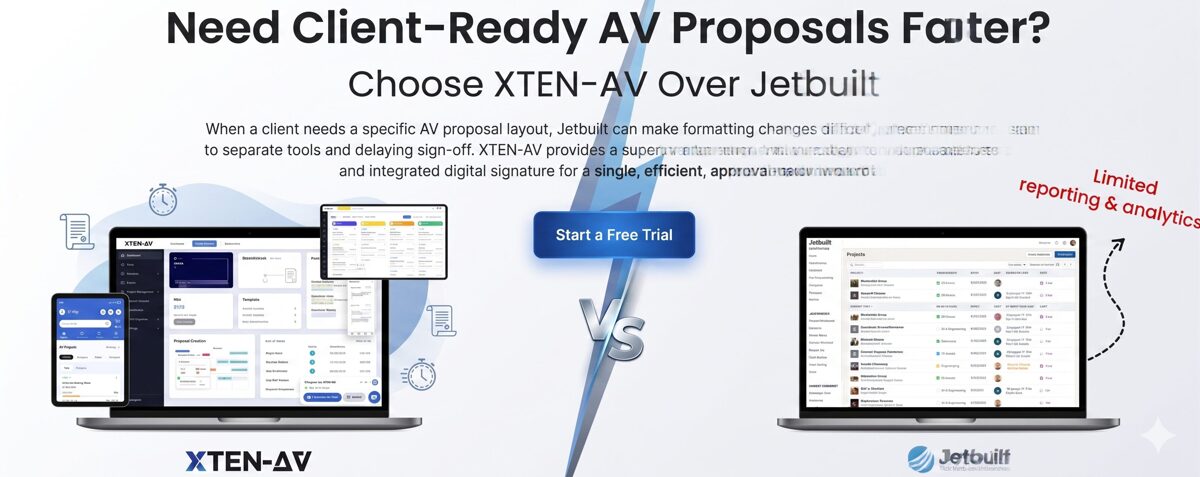
What Is XTEN-AV?
XTEN-AV is a comprehensive, AI-powered AV project automation platform designed specifically for audiovisual system integrators, AV consultants, installation professionals, and system designers. Launched as a next-generation solution to address the software fragmentation plaguing the AV integration industry, XTEN-AV consolidates design, quoting, CAD drawing, proposal generation, project management, and field service workflows into a unified cloud-based ecosystem.
Platform Philosophy
Unlike specialized point solutions, XTEN-AV operates on a unified data model where equipment selections, system designs, technical drawings, proposals, and project documentation share a single source of truth. This architecture eliminates the data synchronization challenges and workflow friction created by moving information between disconnected applications.
Core Capabilities
XTEN-AV encompasses:
AI-assisted system design and automated drawing generation
Professional CAD capabilities for schematics, rack elevations, and signal flow diagrams
Intelligent BOM creation with manufacturer pricing integration
Automated proposal generation using customizable templates
Comprehensive project management with scheduling and labor tracking
Mobile applications for field technician access and time tracking
AV-specific calculators for projector throw, speaker coverage, and system sizing
Digital signature workflows for electronic contract approvals
Target Users
The platform serves AV professionals across multiple specialties:
Residential custom integrators installing home theater, distributed audio, and smart home systems
Commercial AV contractors handling corporate, education, hospitality, and house of worship installations
AV consultants designing systems for architectural firms and end clients
System designers requiring technical documentation and engineering calculations
Sales teams needing rapid proposal turnaround
Project managers tracking multiple concurrent installations
XTEN-AV scales from solo practitioners to enterprise integration companies with hundreds of employees across multiple locations.
What Is Jetbuilt?
Jetbuilt is an established cloud-based AV quoting software that has served the audiovisual integration industry since its inception over a decade ago. The platform focuses primarily on Bill of Materials (BOM) creation, equipment pricing, and basic project organization for AV integrators.
Primary Focus
Jetbuilt concentrates on core quoting functions:
Equipment selection from extensive manufacturer databases
Real-time pricing updates from AV distributors and manufacturers
BOM generation with line-item detail
Labor estimation and margin calculation
Basic project organization and budget tracking
Vendor catalog integration for streamlined product research
Historical Market Position
For many years, Jetbuilt represented a significant improvement over Excel spreadsheets and manual quoting processes. Its manufacturer pricing database containing thousands of AV products helped integrators maintain current costs and improve quotation accuracy.
Platform Limitations
Jetbuilt's scope has remained relatively static while AV project complexity and client expectations have evolved:
No CAD or drawing capabilities: Integrators must use separate design software like AutoCAD, Visio, or D-Tools
No proposal automation: Equipment lists must be exported to Word or other document applications for professional formatting
No mobile applications: Field access requires printing documentation or laptop access
Limited AI features: No intelligent recommendations, automated design, or workflow assistance
Basic project management: Lacks comprehensive scheduling, task assignment, or labor tracking
Single-user focus: Collaboration features remain limited compared to modern cloud-based platforms
These constraints have led many progressive AV integrators to search for more comprehensive alternatives that consolidate multiple workflow phases into unified platforms.
XTEN-AV vs Jetbuilt: Core Platform Overview
Understanding the fundamental architectural differences between XTEN-AV and Jetbuilt provides context for subsequent feature comparisons.
Platform Aspect | XTEN-AV | Jetbuilt |
Platform Type | All-in-one AV project automation | Specialized quoting software |
Architecture | Unified cloud-based ecosystem | Cloud quoting with desktop focus |
Data Model | Integrated single source of truth | BOM-centric with export focus |
Primary Purpose | Design through project delivery | Equipment quoting and BOM |
Core Philosophy | Consolidation and automation | Specialized quoting excellence |
Required Supplements | None—comprehensive platform | CAD software, proposal tools, PM software |
Mobile Strategy | Native iOS and Android apps | No dedicated mobile applications |
AI Integration | Core platform capability | Not available |
User Interface | Modern, intuitive, visual | Functional, data-entry focused |
Collaboration Model | Real-time cloud collaboration | File-based project sharing |
Platform Scope Comparison
XTEN-AV Workflow Coverage:
Initial system design and equipment selection
Automated drawing generation (CAD, schematics, rack layouts)
Proposal creation with professional templates
Digital signature and contract approval
Project scheduling and resource allocation
Installation execution with mobile field access
Time tracking and labor cost capture
Project closeout and as-built documentation
Profitability analysis and business intelligence
Jetbuilt Workflow Coverage:
Equipment selection and BOM creation
Pricing lookups and margin calculation
Basic project organization
Export to external applications for remaining workflows
This fundamental scope difference means XTEN-AV directly addresses complete project lifecycles, while Jetbuilt focuses on a single workflow phase requiring supplementary tools for comprehensive project automation.
AI-Powered AV Automation
Artificial intelligence integration represents the most significant technological differentiator in the XTEN-AV vs Jetbuilt comparison. As of May 2026, AI capabilities have transitioned from experimental features to mission-critical competitive advantages in AV integration workflows.
XTEN-AV: XAVIA AI Agent Capabilities
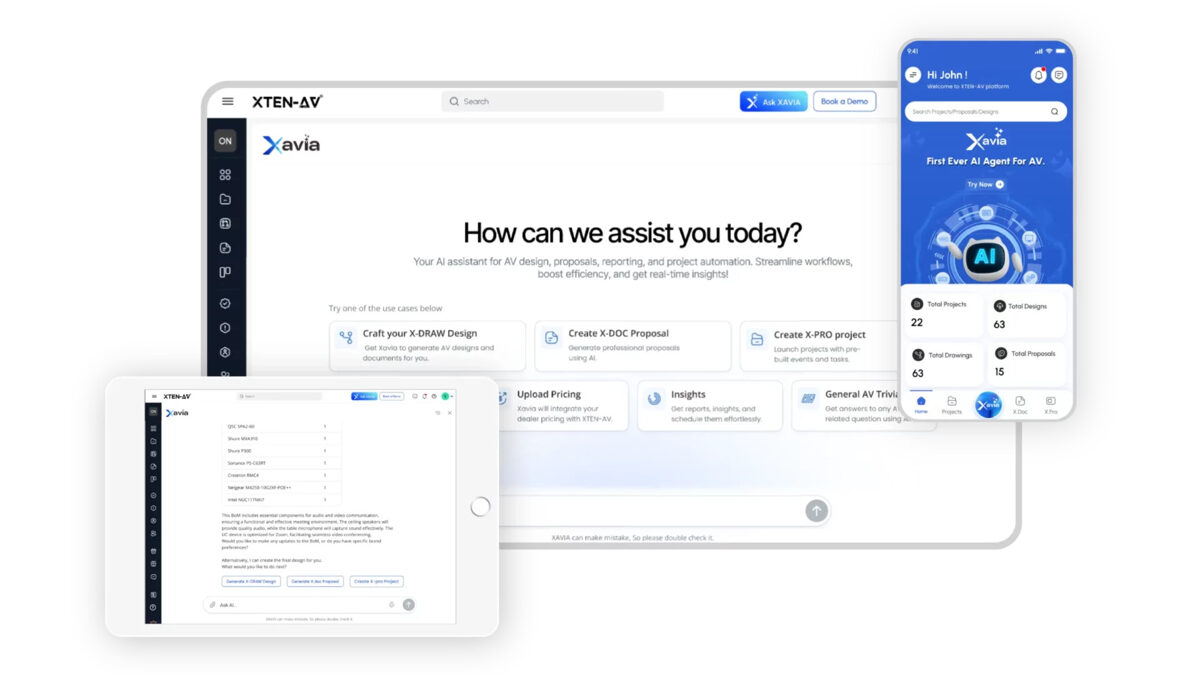
XTEN-AV incorporates the XAVIA AI agent—purpose-built artificial intelligence trained specifically on audiovisual system design, installation practices, and industry standards.
Voice and Chat-Based Workflow Control
Integrators interact with XAVIA through natural language:
"Create a proposal for a 200-seat auditorium with video conferencing and lecture capture"
"Calculate speaker placement for a 60x40 foot worship space"
"Generate a huddle room system with wireless presentation under $15,000"
"Show me projector options for a 15-foot screen at 25 feet throw"
The AI interprets these requests, selects appropriate equipment, generates system designs, creates technical drawings, and produces professional proposals—dramatically reducing manual workflow time.
AI-Assisted AV System Design
XAVIA analyzes project parameters including:
Room dimensions and architectural constraints
Intended use cases and user requirements
Budget parameters and margin targets
Technical specifications (resolution, coverage, bandwidth)
Company preferences for manufacturers and system architectures
Based on this analysis, the AI generates complete system designs with optimized equipment selections and layout recommendations.
Automated Drawing Generation
Describe your AV system in natural language, and XAVIA produces:
System block diagrams showing signal routing
Rack elevation layouts with proper U-space allocation
Wiring schematics with cable types and terminations
Floor plans with equipment placement annotations
Signal flow diagrams for audio and video paths
These AI-generated drawings serve as starting points for customization rather than requiring creation from scratch.
Intelligent BOM Recommendations
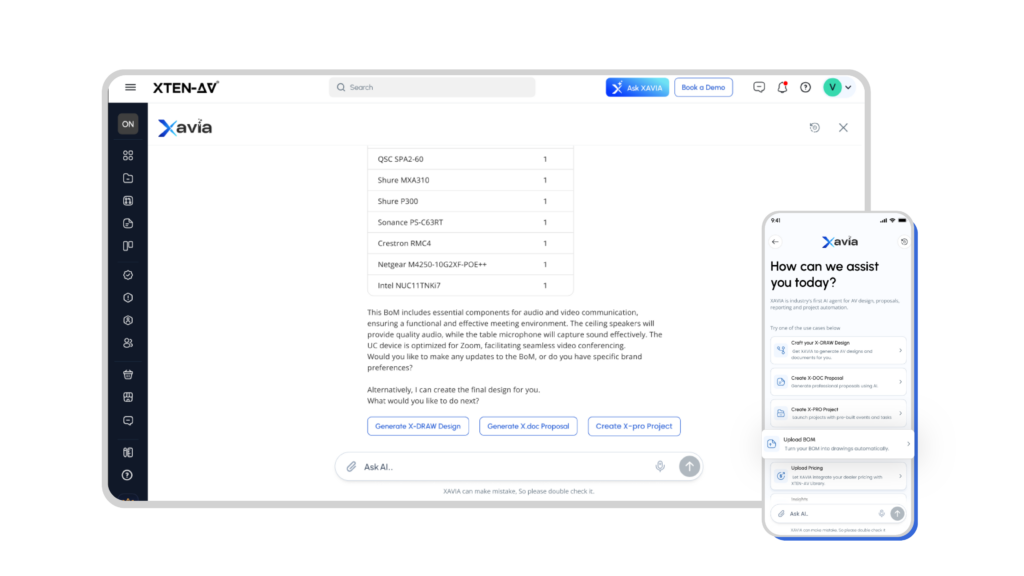
XAVIA doesn't simply search product databases—it applies domain expertise:
Identifies missing accessories (mounts, cables, connectors, power supplies)
Suggests compatible alternatives when preferred products are unavailable
Flags specification conflicts or incompatibilities between selected products
Recommends cost-effective substitutions when equipment is over-specified
Applies company standards and historical preferences automatically
Automated AV Calculations
XAVIA performs complex technical calculations:
Projector throw distances and lens selections
Speaker coverage patterns and SPL requirements
Network bandwidth for IP video distribution
Cable run lengths and voltage drop
Power consumption and BTU load for equipment racks
Viewing angles and display sizing
Jetbuilt: AI Capabilities
Current Status: Jetbuilt does not include AI capabilities as of May 2026.
Available Features: None
Roadmap: No public AI integration announcements
Practical Impact: Integrators using Jetbuilt perform all system design, equipment selection, calculations, and drawing creation manually or with separate tools.
Feature Comparison: AI Automation
AI Capability | XTEN-AV | Jetbuilt |
Voice-activated commands | ✅ Full XAVIA integration | ❌ Not available |
AI system design | ✅ Automated design generation | ❌ Manual selection only |
Intelligent BOM creation | ✅ AI recommendations | ⚠️ Database search only |
Automated drawing generation | ✅ Complete automation | ❌ No drawing capabilities |
Natural language queries | ✅ Conversational interface | ❌ Traditional UI only |
Technical calculation automation | ✅ AI-powered calculators | ⚠️ Manual calculation |
Learning from company data | ✅ Personalized recommendations | ❌ No learning capability |
Proposal automation | ✅ AI-generated content | ❌ Manual document creation |
Productivity Impact
Time savings from XTEN-AV's AI automation:
System design: 3-4 hours → 15-20 minutes (85% reduction)
Technical calculations: 45-60 minutes → 2-3 minutes (95% reduction)
Drawing creation: 2-4 hours → 20-30 minutes (80% reduction)
BOM optimization: 30-45 minutes → 5 minutes (90% reduction)
Cumulative effect: Complete proposals in 1.5-2 hours vs. 6-8 hours with traditional workflows.
AV Design & Drawing Capabilities
Technical documentation represents a critical project deliverable for both residential and commercial AV installations. The ability to produce professional drawings internally versus requiring separate CAD software significantly impacts workflow efficiency and cost structure.
XTEN-AV: Integrated CAD Platform
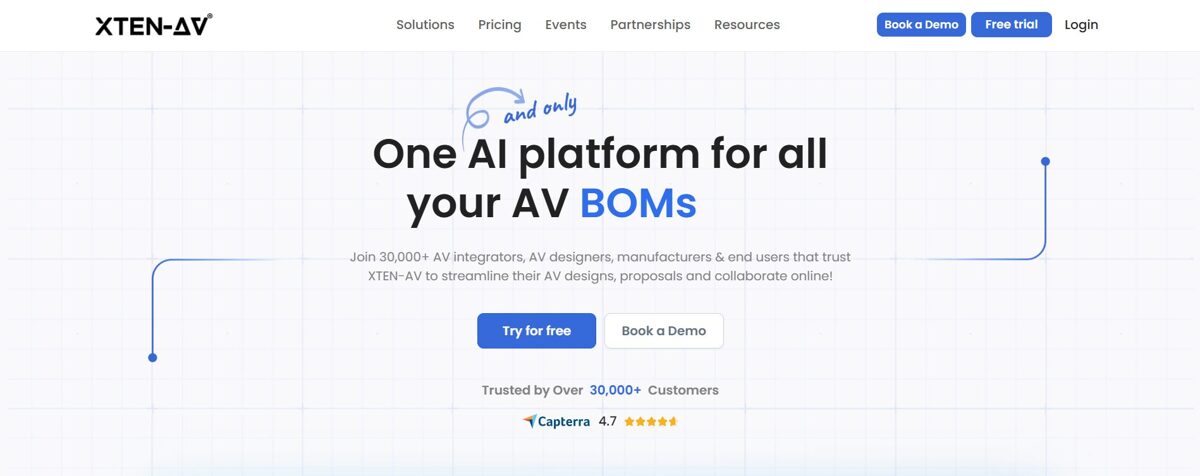
XTEN-AV includes comprehensive computer-aided design capabilities specifically optimized for audiovisual applications.
Automated Schematic Generation
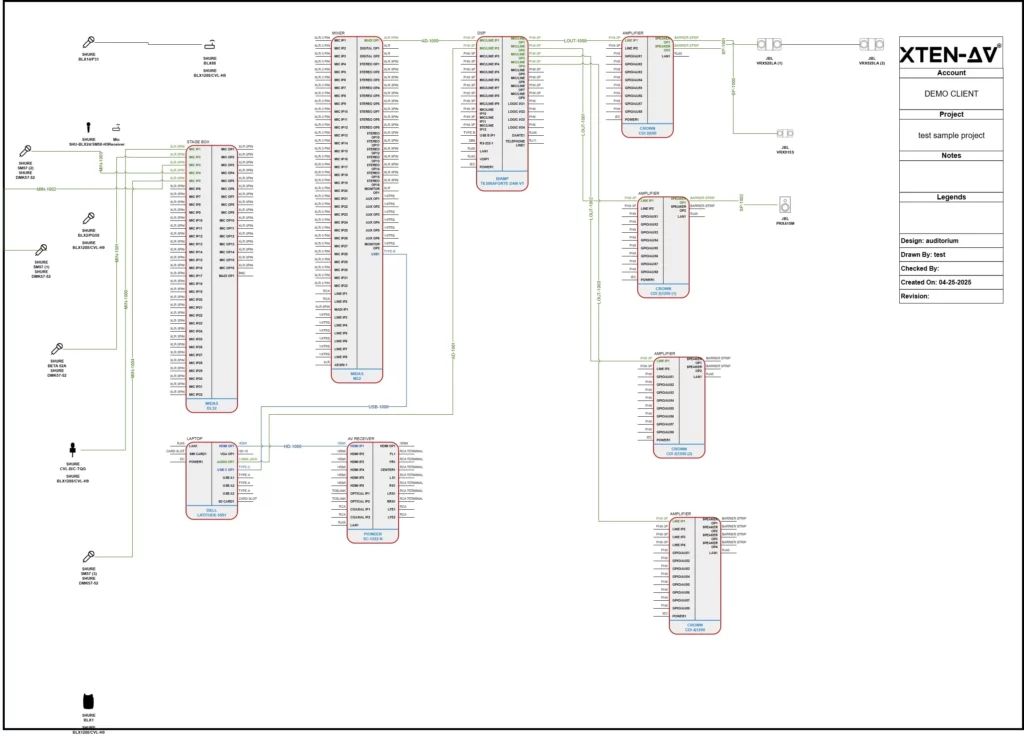
Signal flow diagrams showing audio and video routing between components
System architecture illustrations for client presentations and technical reviews
Block diagrams explaining system topology and control relationships
One-line drawings documenting power distribution and network connectivity
Rack Elevation Designer
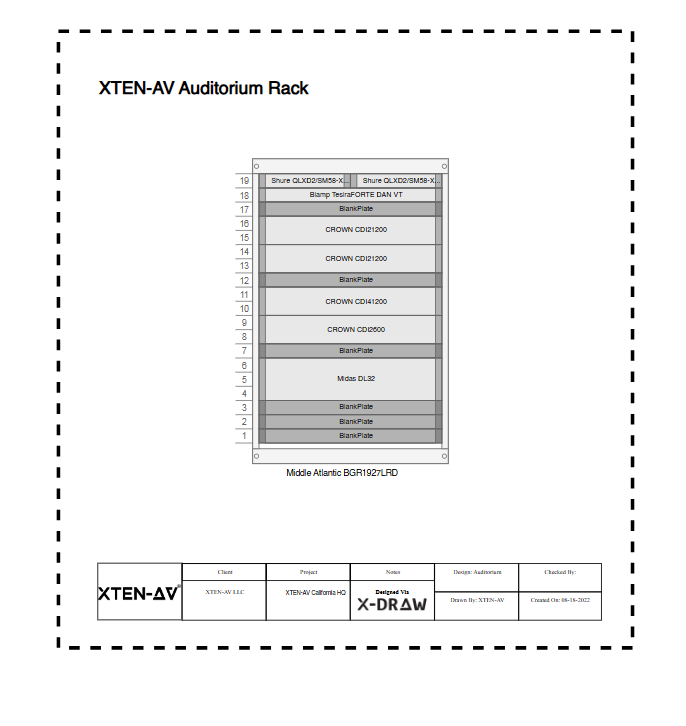 Professional equipment rack layouts with:
Automatic U-space calculation preventing overcrowding
Equipment mounting position with proper ventilation spacing
Power distribution showing PDU locations and circuit assignments
Cable management indicating patch panel connections
Thermal load calculations for cooling requirements
Weight distribution for structural considerations
Floor Plan Annotation
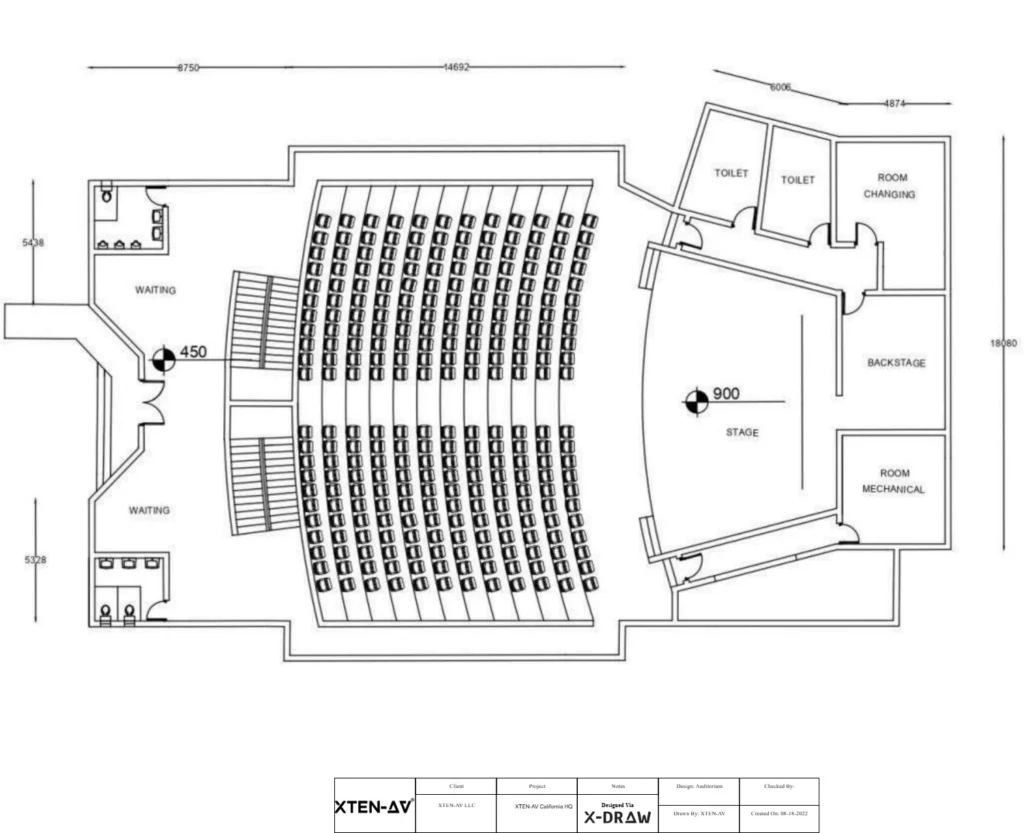
Import existing architectural drawings (PDF, DWG, DXF)
Add AV equipment symbols from pre-built library
Annotate speaker placement with coverage zones
Indicate display locations with viewing angles
Show cable pathways and conduit routing
Label equipment rooms and closet locations
Automatic Cable Labeling
Auto-generated cable labels linked to BOM line items
Consistent naming conventions across all project drawings
Source-to-destination labeling for complex systems
Cable type indicators (HDMI, Cat6, speaker wire, control)
Length specifications for field installation
AV-Specific Design Templates
Pre-configured drawing templates for common system types:
Conference room layouts (small, medium, large)
Huddle space configurations
Auditorium and lecture hall systems
Home theater designs
Distributed audio system topologies
Digital signage network layouts
Classroom AV installations
BOM-Linked Documentation
Critical advantage: When equipment changes in the BOM, associated drawings automatically update:
Modify a display model, and floor plans reflect the new specification
Change a processor, and rack elevations and signal flow diagrams update
Add amplifiers, and power calculations automatically adjust
This synchronization eliminates the version control nightmares of managing separate CAD files.
Pre-Built Product Library
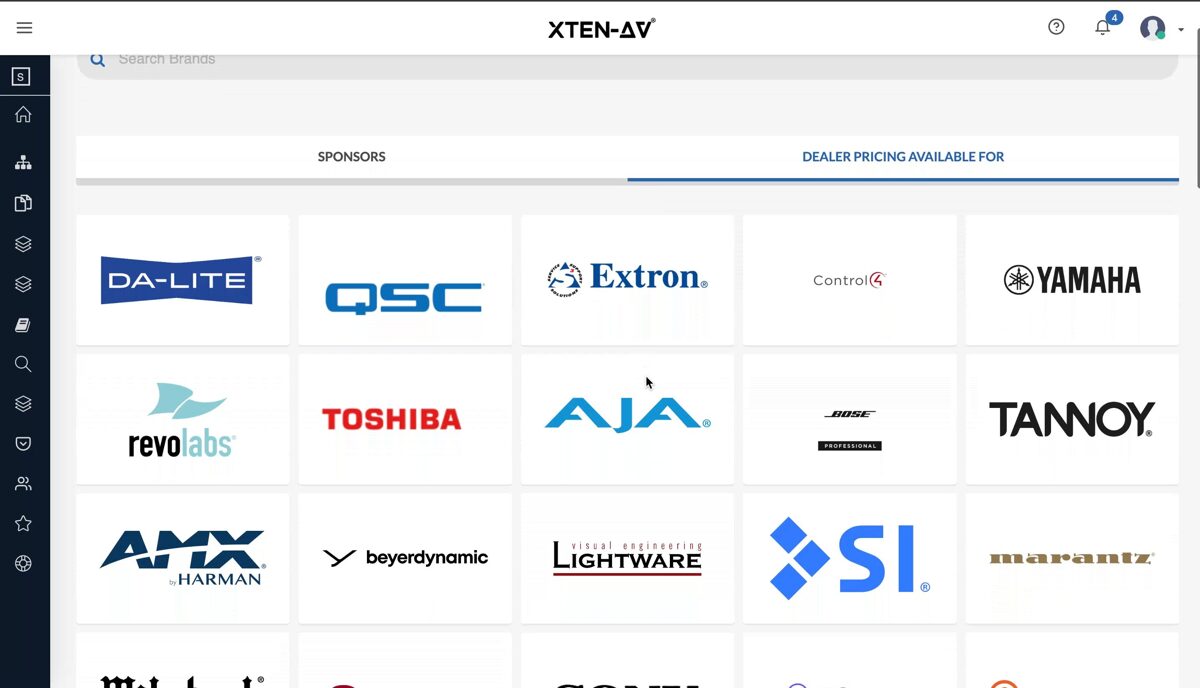
XTEN-AV includes:
1,000+ AV equipment symbols for major manufacturers
Standard electrical symbols (outlets, circuits, junction boxes)
Architectural elements (walls, doors, furniture)
Network symbols (switches, routers, access points)
Custom symbol creation for specialized equipment
Jetbuilt: Drawing Capabilities
Current Status: Jetbuilt does not include drawing or CAD capabilities.
Available Features: None
Required Supplement: Integrators must use:
AutoCAD ($1,800/year per user)
Visio ($360/year per user)
D-Tools System Integrator ($1,500-3,000/year)
Free tools (with limited capabilities)
Workflow Impact:
BOM data must be manually transferred to CAD software
Equipment changes require manual drawing updates
No synchronization between quote and technical documentation
Version control challenges managing separate file types
Feature Comparison: Design & Drawing
Design Capability | XTEN-AV | Jetbuilt |
Signal flow diagrams | ✅ Automated generation | ❌ Requires external software |
Rack elevation layouts | ✅ Built-in designer | ❌ Requires external software |
Floor plan annotation | ✅ Integrated tools | ❌ Requires external software |
Automatic cable labeling | ✅ BOM-linked | ❌ Not applicable |
CAD import/export | ✅ DWG, DXF, PDF | ❌ No drawing capabilities |
AV symbol library | ✅ 1,000+ symbols | ❌ Not applicable |
Drawing templates | ✅ Pre-configured layouts | ❌ Not applicable |
BOM-drawing sync | ✅ Automatic updates | ❌ Manual coordination |
3D visualization | ✅ Rack elevations | ❌ Not available |
Cost Implications
Annual savings with XTEN-AV's integrated CAD:
For a 5-person integration company:
AutoCAD LT (5 licenses): $9,000/year
Training time (40 hours @ $50/hr): $2,000
Version control overhead: $1,500 (estimated time)
Total savings: $12,500/year
Proposal & Documentation Automation
Professional proposal creation directly impacts close rates, client perceptions, and sales cycle length. The ability to generate polished proposals rapidly provides significant competitive advantage.
XTEN-AV: Automated Proposal System
XTEN-AV treats proposal generation as a core automated workflow rather than an export function.
100+ Customizable Templates
Pre-built proposal templates for:
Residential markets: Home theater, whole-house audio, smart home
Commercial sectors: Corporate, education, hospitality, healthcare, worship
Vertical specialties: Sports venues, retail, transportation, government
Proposal types: Design-build, equipment-only, service agreements, maintenance contracts
Each template includes:
Professional layout with table of contents
Executive summary sections
Technical specifications and scope descriptions
Equipment schedules auto-populated from BOMs
Pricing tables with line-item detail or project totals
Terms and conditions customizable by company
Warranty information and support details
Payment schedules and milestone definitions
Automated Content Generation
XTEN-AV populates proposals automatically:
Equipment descriptions pulled from manufacturer specifications
Technical drawings embedded from integrated CAD
System diagrams illustrating functionality
Labor estimates calculated from project scope
Total investment computed with configured margins
Alternative options showing budget tiers or phased approaches
Brand Customization
Companies customize proposals with:
Company logo and brand colors
Custom fonts and style guidelines
Signature blocks for sales representatives
Office locations and contact information
Certifications and manufacturer partnerships
Portfolio photos from previous projects
Digital Signature Integration
Legally binding electronic signatures:
Embedded signature fields in PDF proposals
Email delivery with signature request
Mobile-friendly signing on smartphones and tablets
Audit trail documenting signature timestamp and IP address
Counter-signature workflow for multiple approvers
Automatic contract execution upon all parties signing
Real-Time Proposal Tracking
XTEN-AV monitors proposal engagement:
View tracking: Know when clients open proposals
Time analytics: See how long clients spend reviewing
Forward notifications: Alert when proposals are shared with others
Section engagement: Identify which proposal sections receive most attention
Follow-up reminders: Automated sales team notifications for non-responsive prospects
Automated Cost and Labor Calculations
Dynamic pricing based on:
Equipment costs from BOM totals
Labor hours calculated from system complexity and installation scope
Labor rates configured by technician type and project phase
Overhead multipliers for company operational costs
Profit margins applied at equipment and labor levels
Tax calculations for applicable jurisdictions
Jetbuilt: Proposal Capabilities
Current Features: Basic export functionality
Available Options:
Export BOM to CSV or Excel
Print equipment lists
Basic PDF generation of line-item quotes
Required Workflow:
Export BOM data from Jetbuilt
Open Microsoft Word or Google Docs
Manually format proposal document
Copy equipment information from export
Insert drawings created in separate CAD software
Write scope descriptions and technical explanations
Format pricing tables
Add company branding manually
Save as PDF
Email to client (no tracking or e-signature)
Time Required: 1.5-3 hours per proposal
Limitations:
No proposal templates
No automated content generation
No digital signature integration
No tracking capabilities
Manual formatting required
No BOM synchronization (changes require re-export)
Feature Comparison: Proposals & Documentation
Proposal Feature | XTEN-AV | Jetbuilt |
Pre-built templates | ✅ 100+ industry templates | ❌ None—manual creation |
Automated generation | ✅ One-click from BOM | ⚠️ Export only |
Professional formatting | ✅ Automatic layout | ❌ Manual formatting |
Drawing integration | ✅ Embedded from CAD | ❌ Manual insertion |
Digital signatures | ✅ Built-in e-signature | ❌ Not available |
Proposal tracking | ✅ View and engagement analytics | ❌ No tracking |
Brand customization | ✅ Company branding | ⚠️ Manual application |
Version control | ✅ Automatic revisions | ❌ Manual file management |
Mobile viewing | ✅ Responsive design | ⚠️ PDF only |
Impact on Sales Cycles
Proposal creation time:
XTEN-AV: 15-30 minutes
Jetbuilt + Word: 1.5-3 hours
Average delivery speed:
XTEN-AV: Same day or next day
Jetbuilt workflow: 3-5 days
Close rate improvement with XTEN-AV: 25-35% (attributed to faster delivery and professional presentation)
Project Management & Workflow Tracking
Beyond the initial sale, AV integrators need project execution tools to ensure profitable installations. Project management capabilities distinguish comprehensive platforms from specialized quoting tools.
XTEN-AV: Comprehensive Project Management
XTEN-AV includes full project lifecycle management from contract signature through final commissioning.
Task Assignment and Scheduling
Create project tasks for installation phases, programming, commissioning
Assign tasks to specific technicians, project managers, or subcontractors
Set dependencies establishing sequential workflows
Define deadlines with automated reminders
Gantt chart visualization showing project timeline
Calendar integration syncing with team calendars
Real-Time Project Analytics
Dashboard views showing:
Budget consumption: Actual costs vs. estimates
Labor utilization: Hours spent by task and technician
Project profitability: Real-time margin calculations
Schedule variance: On-time vs. delayed milestones
Equipment status: Ordered, received, installed
Outstanding tasks: Incomplete items by priority
Labor Cost and Profitability Tracking
Time tracking integrated with task assignments
Labor rate application based on technician classifications
Overtime calculations for extended hours
Actual vs. estimated labor comparisons
Gross profit analysis by project phase
Resource utilization reports identifying overburdened staff
Technician Clock-In/Clock-Out
Mobile app functionality:
GPS-verified clock-in at job sites
Task-specific time capture showing hours by installation phase
Break tracking for accurate labor accounting
Photo documentation during time entries
Daily reports summarizing work completed
Automated payroll export for accounting systems
Mobile Access for Field Technicians
iOS and Android apps provide:
Project drawing access on tablets
Equipment list verification
Installation checklist completion
Photo documentation with automatic project association
Issue reporting with immediate project manager notification
Client signature capture for completion verification
Centralized Documentation
All project-related documents in one location:
Contracts and change orders
Technical drawings and as-builts
Equipment manuals and warranty documentation
Client communications and approval emails
Photos from field installations
Punch lists and completion certificates
Jetbuilt: Project Management Capabilities
Current Features: Basic project organization
Available Functions:
Project creation with client information
BOM organization by room or system
Basic notes and comments
Export to external project management tools
Not Included:
No task assignment or scheduling
No labor tracking or time capture
No profitability analytics
No mobile field access
No document management
No technician clock-in/out
No project analytics or reporting
Required Supplements:
Procore ($400-1,200/user/year)
BuilderTREND ($299-699/month company-wide)
Monday.com ($8-16/user/month)
Separate time tracking tools
Feature Comparison: Project Management
Project Management Feature | XTEN-AV | Jetbuilt |
Task assignment | ✅ Full scheduling system | ❌ Not available |
Gantt charts | ✅ Timeline visualization | ❌ Not available |
Labor time tracking | ✅ Mobile clock-in/out | ❌ Requires separate tool |
Profitability analytics | ✅ Real-time calculations | ❌ Not available |
Mobile field access | ✅ iOS and Android apps | ❌ No mobile apps |
Document management | ✅ Centralized storage | ⚠️ Basic file attachment |
Budget tracking | ✅ Actual vs. estimate | ⚠️ BOM cost only |
Resource allocation | ✅ Team scheduling | ❌ Not available |
Client communication | ✅ Integrated messaging | ❌ External email |
Business Impact
Operational efficiency with XTEN-AV project management:
15-20% reduction in project administration time
40% improvement in labor cost accuracy through automated time tracking
25% faster project completion from better scheduling and task visibility
30% reduction in profit margin erosion through real-time budget monitoring
Cloud Collaboration & Accessibility
Modern AV integration businesses operate with distributed teams, remote project managers, and field technicians across multiple job sites. Cloud collaboration capabilities directly impact operational flexibility and team productivity.
XTEN-AV: Cloud-Native Architecture
XTEN-AV operates as a fully cloud-based platform designed for multi-user collaboration.
Access from Any Device
Desktop browsers: Windows, Mac, Linux (Chrome, Firefox, Safari, Edge)
Tablet access: iPad, Android tablets with touch-optimized interface
Smartphone access: iPhone, Android phones with responsive design
No software installation: Instant access via web browser
Automatic updates: Latest features without manual updates
iOS and Android Mobile Applications
Native mobile apps provide:
Full-featured access to all platform capabilities
Offline mode for viewing drawings and documentation without connectivity
Camera integration for photo documentation
GPS capabilities for location-verified time tracking
Push notifications for task assignments and project updates
Barcode scanning for equipment verification
Real-Time Team Collaboration
Simultaneous access enabling:
Multiple users editing projects concurrently
Instant updates visible to all authorized team members
Version control preventing conflicting edits
Change tracking showing who modified what and when
Comment threads for design discussions without email chains
@mentions for directing attention to specific team members
Role-Based Permissions
Granular access control:
Administrators: Full platform configuration and user management
Project Managers: Complete project access and team coordination
Sales Team: Proposal creation and client interaction
Designers: System design and drawing creation
Field Technicians: Read-only drawings and time tracking
Clients: Limited portal access for proposal review and project status
Remote Project Management
Distributed team capabilities:
Project managers oversee installations from remote offices
Sales teams create proposals while traveling
Designers collaborate on system designs from home offices
Field technicians access current drawings on job sites
Executives monitor company-wide metrics from anywhere
Data Security and Backup
Enterprise-grade encryption (SSL/TLS for transmission, AES-256 for storage)
Automatic daily backups with redundant storage
99.9% uptime guarantee with redundant servers
GDPR compliance for international operations
Two-factor authentication for enhanced account security
Jetbuilt: Cloud and Collaboration
Current Architecture: Cloud-based with desktop-focused interface
Collaboration Features:
Cloud storage of project files
Basic sharing via Jetbuilt accounts
Comment functionality on line items
PDF exports for email sharing
Limitations:
No mobile applications—field access requires browser on mobile devices (poor experience)
Single-user editing—no true simultaneous collaboration
Limited permissions—basic user roles only
Desktop-optimized UI—not responsive on tablets or phones
No offline access—requires constant internet connectivity
Practical Impact:
Field teams must print documentation or carry laptops
Remote project managers experience workflow friction
Mobile professionals have limited productivity on the go
Feature Comparison: Cloud & Mobile
Cloud/Mobile Feature | XTEN-AV | Jetbuilt |
Native mobile apps | ✅ iOS and Android | ❌ No mobile apps |
Tablet optimization | ✅ Touch-friendly interface | ⚠️ Desktop UI only |
Offline mode | ✅ View drawings without internet | ❌ Requires connectivity |
Real-time collaboration | ✅ Simultaneous editing | ⚠️ Single-user focus |
Mobile time tracking | ✅ GPS-verified clock-in | ❌ Not available |
Photo documentation | ✅ Camera integration | ❌ Not available |
Role-based permissions | ✅ Granular access control | ⚠️ Basic roles only |
Client portal | ✅ Dedicated client access | ❌ Not available |
Productivity Impact
Teams using XTEN-AV's mobile capabilities report:
30% reduction in printed documentation costs
20% improvement in field technician productivity through on-site information access
50% faster issue resolution via mobile photo reporting
25% improvement in remote team coordination through real-time updates
Which Platform Is Better for AV Project Automation?
After comprehensive feature-by-feature analysis, clear patterns emerge in the XTEN-AV vs Jetbuilt comparison that guide AV integrators toward the best software investment for their project automation needs.
When XTEN-AV Is the Clear Winner
XTEN-AV emerges as the best AV Jetbuilt alternative software when you need:
Comprehensive Project Automation
If your goal is end-to-end workflow automation from initial design through final commissioning, XTEN-AV's unified platform eliminates the software fragmentation inherent in Jetbuilt-based workflows.
AI-Powered Productivity
Integrators seeking dramatic time savings through intelligent automation gain transformative capabilities with XAVIA AI agent—capabilities completely absent from Jetbuilt.
Integrated CAD and Drawing
Companies tired of paying for separate AutoCAD subscriptions or managing disconnected drawing files benefit from XTEN-AV's built-in CAD platform with BOM synchronization.
Professional Proposal Generation
Sales teams requiring rapid, polished proposals to win competitive bids leverage XTEN-AV's automated proposal system versus Jetbuilt's manual export workflow.
Mobile Field Operations
Organizations with field technicians needing on-site access to drawings, BOMs, and time tracking require XTEN-AV's native mobile apps—Jetbuilt offers nothing for mobile workers.
Real-Time Collaboration
Distributed teams, multi-location companies, and remote project managers demand cloud collaboration—XTEN-AV delivers true real-time workflows.
Complete Project Management
Integrators seeking single-platform task scheduling, labor tracking, and profitability analytics avoid the cost and complexity of supplementary PM software with XTEN-AV.
Platform Consolidation
Companies wanting to reduce software expenses and eliminate workflow friction benefit from XTEN-AV's all-in-one architecture versus maintaining Jetbuilt plus CAD plus proposal tools plus PM software.
When Jetbuilt Might Suffice
Jetbuilt may remain adequate for:
Simple Equipment Quoting
If your workflow is limited to generating equipment lists with current pricing, and you already have robust solutions for design, proposals, and project management, Jetbuilt's focused quoting capability may suffice.
Legacy Workflow Dependency
Companies with deeply entrenched workflows built around Jetbuilt's specific data structure or custom API integrations may face short-term friction during transition.
Budget-Constrained Scenarios
Organizations focused solely on quoting functionality and unwilling to invest in comprehensive automation might view Jetbuilt's narrower scope as acceptable.
However, even these scenarios increasingly represent false economy—the hidden costs of manual workflows, disconnected tools, and missed opportunities typically exceed the incremental investment in comprehensive platforms like XTEN-AV.
Total Cost of Ownership Analysis
Jetbuilt-Based Workflow (per user):
Jetbuilt subscription: $900/year
AutoCAD LT: $1,800/year
Proposal software: $400/year
Project management: $800/year
Mobile time tracking: $300/year
Total: $4,200/year
Plus: Time cost of data transfer between platforms
XTEN-AV (per user):
Comprehensive platform: $2,800-3,600/year (typical range)
No additional software required
Savings: $600-1,400/year per user
Plus: Eliminated workflow friction and productivity gains
For a 5-person integration company:
Annual savings: $3,000-7,000
Plus: AI-driven productivity improvements valued at $15,000-25,000 annually
The Verdict
XTEN-AV represents the best AV Jetbuilt alternative software for AV integrators in 2026 because it addresses complete project automation rather than isolated quoting functions. The feature gap documented throughout this comparison demonstrates that Jetbuilt serves a single workflow phase while XTEN-AV encompasses entire project lifecycles.
Modern AV integration businesses require:
AI automation for competitive speed
Integrated design tools for comprehensive documentation
Mobile capabilities for field productivity
Real-time collaboration for distributed teams
Project management for profitable execution
XTEN-AV delivers all these capabilities in a unified platform. Jetbuilt delivers quoting—requiring supplementary tools for everything else.
The decision comes down to whether you view software as isolated point solutions or strategic business infrastructure. Forward-thinking integrators recognize that comprehensive automation platforms provide competitive advantages that fragmented toolsets cannot match.
Frequently Asked Questions
Can XTEN-AV import my existing Jetbuilt projects and equipment libraries?
Yes, XTEN-AV provides data migration services during onboarding that can import your equipment databases, vendor pricing, custom products, standard BOMs, and customer information from Jetbuilt. The migration team works with your data to map Jetbuilt's structure to XTEN-AV's database, ensuring you retain historical project information and don't need to recreate product libraries. Custom equipment items, special pricing arrangements, and company preferences transfer intact. The process typically takes 3-7 days depending on data volume, with migration specialists validating accuracy before go-live. This allows you to start using XTEN-AV with your existing institutional knowledge preserved while gaining access to expanded capabilities.
Does XTEN-AV's AI actually work well for complex commercial AV systems?
Yes, XTEN-AV's XAVIA AI agent is specifically trained on complex commercial AV applications including corporate conferencing, education systems, large-venue installations, and integrated building systems. The AI understands advanced concepts like Dante audio networking, HDBaseT infrastructure, control system integration, DSP programming requirements, and multi-zone video distribution. For complex projects, XAVIA serves as an intelligent starting point rather than a complete solution—it generates base system designs and equipment recommendations that experienced designers then refine. The AI learns from your company's project history, so recommendations become increasingly aligned with your design philosophy and preferred manufacturers over time. Users report that XAVIA accelerates even complex commercial designs by 40-60% compared to starting from scratch.
What happens if I need drawings in AutoCAD format for architects or general contractors?
XTEN-AV exports drawings in industry-standard formats including DWG (AutoCAD), DXF, and PDF with full layer control and proper scaling. When you export drawings to DWG format, they open directly in AutoCAD, Revit, or other CAD programs used by architects and general contractors. The export maintains all drawing elements, layers, dimensions, and annotations, allowing design teams to incorporate your AV drawings into architectural plans or construction documents. Additionally, XTEN-AV can import architectural drawings in DWG or PDF format, allowing you to annotate existing floor plans rather than redrawing them. This bidirectional compatibility ensures seamless collaboration with other design professionals without requiring them to access XTEN-AV directly.
How does XTEN-AV handle manufacturer pricing updates compared to Jetbuilt?
XTEN-AV maintains real-time pricing integration with major AV distributors and manufacturers, similar to Jetbuilt's approach. Pricing updates occur automatically, typically daily or weekly depending on manufacturer, ensuring quotes reflect current market pricing. Additionally, XTEN-AV allows you to configure custom pricing from your preferred vendors and dealer accounts, which takes priority over standard pricing. The platform also includes pricing aging notifications—alerting you when quote pricing is more than 30-60-90 days old and may need refreshing before proposal delivery. One advantage over Jetbuilt: When pricing changes, XTEN-AV's BOM-linked architecture means proposals and drawings can be updated simultaneously, whereas Jetbuilt requires re-export to external proposal documents.
Can field technicians really access everything they need on smartphones?
Yes, XTEN-AV's native mobile applications for iOS and Android provide comprehensive field access optimized for smartphone and tablet screens. Field technicians can:
View full-resolution drawings with pinch-to-zoom capabilities
Access complete equipment lists with specifications
Reference installation instructions and mounting templates
Capture photos that automatically associate with project files
Report issues or equipment problems with immediate project manager notification
Clock in/out with GPS verification
Mark tasks complete as installation progresses
View today's schedule and assigned tasks
The mobile interface is specifically designed for field use with large buttons, high-contrast displays for outdoor visibility, and simplified navigation for gloved hands. Offline mode allows viewing drawings and BOMs even without cellular connectivity, with automatic synchronization when connection restores.
Is XTEN-AV suitable for small residential integrators or just large commercial companies?
XTEN-AV is explicitly designed to serve businesses of all sizes from solo residential installers to national commercial integration firms. Small residential integrators particularly benefit from:
Template-based workflows requiring minimal technical expertise to produce professional results
AI assistance that effectively gives a 1-2 person company the capabilities of larger competitors
Rapid proposal generation allowing small teams to respond to more opportunities
Affordable pricing tiers scaled to company size
Minimal training requirements—most residential integrators become productive within 2-3 days
The platform doesn't require using all features—a residential installer might focus primarily on proposals and basic drawings while ignoring advanced project management or labor analytics relevant to larger firms. As your business grows, you can progressively adopt additional features without changing platforms. Many users report that XTEN-AV actually delivers greater value for small companies than large enterprises because the AI automation provides force multiplication that disproportionately benefits resource-constrained teams.
What kind of training and support does XTEN-AV provide during the transition from Jetbuilt?
XTEN-AV offers comprehensive transition support specifically designed for Jetbuilt users:
Comparative training sessions highlighting workflow differences between platforms
Data migration assistance transferring equipment libraries and project data
Jetbuilt workflow mapping showing how familiar processes translate to XTEN-AV
Live onboarding sessions via screen sharing with training specialists
Video tutorials demonstrating common tasks for former Jetbuilt users
Email and chat support during transition period (typically 30-60 days)
Follow-up check-ins at 1 week, 1 month, and 3 months post-migration
User community forums where transitioning integrators share tips and best practices
Most Jetbuilt users report being fully productive in XTEN-AV within 1-2 weeks, with ongoing discovery of advanced features continuing for months. The learning curve is minimal because fundamental AV concepts (BOMs, equipment selection, proposals) remain consistent—only the implementation and automation improve.
Conclusion
This feature-by-feature comparison of XTEN-AV vs Jetbuilt reveals fundamental differences in platform scope, technological sophistication, and strategic vision for AV project automation. While Jetbuilt remains a competent equipment quoting tool, its feature set hasn't evolved to address the comprehensive workflow needs of modern AV integration businesses in 2026.
XTEN-AV emerges as the best AV Jetbuilt alternative software through:
AI-Powered Automation: XAVIA AI agent delivers transformative productivity through voice-activated workflows, intelligent system design, automated drawing generation, and proposal automation—capabilities completely absent from Jetbuilt.
Integrated CAD Platform: Built-in drawing capabilities eliminate expensive AutoCAD subscriptions while maintaining perfect synchronization between BOMs and technical documentation.
Professional Proposal System: 100+ automated templates with digital signatures and real-time tracking replace manual Word document creation and email delivery.
Comprehensive Project Management: Task scheduling, labor tracking, profitability analytics, and mobile field access extend automation beyond quoting into profitable execution.
Cloud Collaboration: Real-time team workflows with native mobile applications support distributed operations and field productivity.
Platform Consolidation: Unified architecture eliminates $2,000-4,000 per user annually in supplementary software costs while removing workflow friction from disconnected tools.
The total cost analysis demonstrates that XTEN-AV typically costs less than maintaining Jetbuilt plus necessary supplements, while delivering dramatically superior capabilities. When productivity improvements from AI automation are factored, the business case becomes overwhelming.
AV integrators evaluating project automation software in 2026 face a straightforward choice: continue with fragmented workflows requiring multiple specialized tools, or embrace comprehensive platforms that address complete project lifecycles. Choosing the best AV Jetbuilt alternative software means recognizing that quoting represents merely one phase of AV project delivery—successful companies automate design, documentation, proposal creation, project execution, and business intelligence with equal sophistication.
XTEN-AV delivers that comprehensive automation, positioning your integration business for competitive success in an industry where speed, sophistication, and operational efficiency increasingly determine market winners.