Home Theater AV Equipment Guide: Best Setup for Immersive Entertainment
Creating exceptional home theater experiences demands far more than simply purchasing expensive Audio Visual (a/v) equipment and placing it in a dedicated room. As residential entertainment systems evolve in 2026, the gap between mediocre installations and truly immersive environments comes down to strategic planning, proper equipment selection, and expert system integration. The importance of choosing the best Audio Visual (a/v) equipment extends beyond brand names and specifications—it requires understanding room acoustics, viewing geometry, signal flow, and how individual components work together as a cohesive ecosystem.
For AV integrators and system designers, modern home theaters present unique challenges: clients expect cinema-quality experiences that rival commercial theaters, seamless smart home integration, future-proof technology, and intuitive operation that non-technical family members can master. Whether designing a dedicated home cinema, upgrading an existing media room, or creating a multi-purpose entertainment space, success depends on balancing technical performance, aesthetic integration, and budgetary constraints.
This comprehensive guide examines the essential equipment categories, design considerations, and emerging technologies shaping home theater installations in 2026, providing AV professionals with actionable insights for delivering exceptional results.
Key Takeaways
Home theater AV systems require integrated design combining video displays, audio systems, source devices, control platforms, and room treatments
Audio quality determines immersive experience more than video resolution—invest in proper speaker placement and acoustic optimization
4K and 8K displays demand appropriate viewing distances: 1.5x screen height for 4K, 0.75x for 8K
Dolby Atmos and DTS:X object-based audio create three-dimensional soundscapes through ceiling speakers and height channels
Room dimensions and acoustic characteristics impact equipment selection more than client preferences alone
AI-powered calibration tools optimize audio/video performance automatically, reducing commissioning time by 60%
HDMI 2.1 connectivity is essential for 8K/60Hz, 4K/120Hz gaming, eARC audio, and variable refresh rates
Projector technology now rivals flat panels in brightness and color accuracy while offering scalable screen sizes
Smart home integration with Control4, Crestron, Savant enables unified operation across entertainment, lighting, shading
Acoustic treatment should consume 15-20% of total budget for professional-grade results
AV design software streamlines planning, prevents installation errors, and ensures optimal equipment placement
What Is a Home Theater AV System?
A home theater AV system is a carefully integrated collection of Audio Visual (a/v) equipment designed to recreate the cinematic experience within a residential environment. Unlike simple TV setups with soundbars, true home theaters employ multi-channel audio systems, calibrated video displays, dedicated source components, and acoustically optimized rooms delivering performance approaching or exceeding commercial cinema standards.
Core Components of Home Theater Systems
Professional home theaters consist of five primary subsystems:
1. Video Display System
Large-format display (projector with acoustically transparent screen or flat panel)
Video processor for scaling, color correction, and source switching
Calibration equipment ensuring accurate color reproduction and contrast
2. Audio Reproduction System
Multi-channel amplification powering discrete speaker arrays
Loudspeakers: front stage (LCR), surround speakers, subwoofers, height channels
Audio processor with room correction and format decoding
3. Source Devices
4K/8K Blu-ray players with HDR support
Streaming devices (Apple TV 4K, NVIDIA Shield, dedicated servers)
Gaming consoles (PlayStation 5 Pro, Xbox Series X)
Media servers with ripped content and metadata management
4. Control and Automation
Universal remote or touchscreen interface
Smart home integration controlling lighting, HVAC, shading
Activity-based control ("Watch Movie" triggers all necessary systems)
Voice control via Alexa, Google Assistant, or proprietary platforms
5. Infrastructure
HDMI matrix switches and signal distribution
Network connectivity supporting 4K streaming and firmware updates
Rack systems housing equipment with proper cooling
Power conditioning and surge protection
Cable management and concealment
Home Theater vs. Media Room vs. Dedicated Cinema
Characteristic | Media Room | Home Theater | Dedicated Cinema |
Primary Use | Multi-purpose | Entertainment-focused | Movie viewing only |
Room Control | Ambient light present | Controlled lighting | Complete light control |
Seating | Standard furniture | Reclining chairs | Theater seating, multiple rows |
Audio | 5.1 or soundbar | 7.1.4+ Atmos | 9.2.6+ immersive audio |
Acoustics | Minimal treatment | Strategic absorption/diffusion | Comprehensive acoustic design |
Budget | $10,000-$30,000 | $30,000-$100,000 | $100,000-$500,000+ |
Why Investing in the Right Home Theater AV Equipment Matters
The Experience Premium
Exceptional home theaters deliver tangible lifestyle benefits justifying significant investment:
Entertainment Value:
Return on investment through reduced theater visits (family of 4 saves $3,000+ annually)
Premium content access: streaming services offering Dolby Vision, Dolby Atmos exclusive releases
Gaming performance: 120Hz refresh rates and VRR creating competitive advantages
Sports viewing with immersive audio replicating stadium atmosphere
Property Value:
High-end theaters increase home values 3-5% in luxury markets
Desirable amenity for discriminating buyers
Professional installation documentation enhances resale appeal
Social Connection:
Private screening rooms become gathering spaces for family and friends
Shared experiences creating lasting memories
Alternative to public venues with superior comfort and convenience
The Cost of Poor Design
Inadequate planning creates expensive problems:
Performance Limitations:
Undersized displays failing to create immersive experience at viewing distances
Poor speaker placement destroying surround effects and sound localization
Inadequate acoustics causing echo, flutter, and muddy bass
Insufficient amplification resulting in dynamic compression during action sequences
Technical Issues:
HDMI compatibility problems preventing format playback
Network bandwidth inadequate for 4K/8K streaming
Thermal problems from improper equipment ventilation
Ground loops and RF interference creating hum and noise
Usability Failures:
Complex operation preventing family members from using system
Source switching problems interrupting viewing experiences
Incompatible formats frustrating users
Maintenance nightmares from inaccessible equipment
Professional Integration Value
Experienced AV integrators deliver:
Acoustic analysis determining optimal equipment and treatment
Custom calibration achieving reference-quality video and audio
Hidden technology maintaining aesthetic goals
Comprehensive warranties and ongoing support
Future-proofing through strategic infrastructure planning
Essential Home Theater AV Equipment Checklist
Display Technology
The video display forms the visual foundation of home theater experiences.
Projection Systems
Laser projectors dominate high-performance home cinema in 2026:
Advantages:
Scalable screen sizes (100"-300"+) creating truly immersive experiences
HDR performance rivaling flat panels with 3,000+ lumens brightness
Longer lifespan (20,000-30,000 hours) versus lamp-based systems
4K native resolution with pixel shifting creating pseudo-8K
Acoustically transparent screens enabling behind-screen speakers
Key specifications:
Resolution:
4K DLP (3840x2160) for screen sizes up to 150"
Native 4K LCOS/SXRD for premium installations
8K shift technology for 200"+ screens
Brightness:
2,000-3,000 lumens for dedicated theaters with complete light control
3,000-5,000 lumens for media rooms with ambient light
5,000+ lumens for large screens (200"+) or high ambient light
Contrast ratio:
Native contrast: 10,000:1 minimum for deep blacks
Dynamic contrast (with iris): 1,000,000:1+ for HDR
HDR formats:
HDR10 (baseline standard)
HDR10+ (dynamic metadata)
Dolby Vision (superior dynamic range)
HLG (broadcast HDR)
Leading projector manufacturers:
Sony VPL-VW915ES (native 4K SXRD, reference quality)
JVC DLA-NZ9 (8K e-shift, laser phosphor)
Epson Pro Cinema LS12000 (laser 3LCD, excellent value)
Barco Residential (ultra-premium cinema reference)
Flat Panel Displays
Large-format TVs work well for smaller spaces or multi-purpose rooms:
Advantages:
Simpler installation without projector mounting and screen
Ambient light tolerance maintaining visibility in daylight
Lower maintenance with no lamp/filter replacements
Integrated smart features reducing external device requirements
Panel technologies:
OLED (Organic Light Emitting Diode):
Perfect blacks (individual pixel dimming)
Infinite contrast ratio
Wide viewing angles
Potential burn-in concern with static content
Available up to 97" (LG, Sony)
Mini-LED LCD:
Extremely high brightness (2,000+ nits peak)
Thousands of local dimming zones
No burn-in risk
Available up to 98" (Samsung, TCL)
Micro-LED:
Modular design supporting custom sizes
Commercial-grade reliability
Outstanding brightness and color
Premium pricing ($50,000+)
Available 110"-146" (Samsung The Wall)
Essential display features:
HDMI 2.1 with eARC, ALLM, VRR, QMS
120Hz refresh rate for gaming and motion handling
Wide color gamut (DCI-P3 90%+)
Low input lag (<20ms) for gaming
Professional calibration modes (Day/Night picture settings)
Audio Systems
Immersive audio creates the emotional impact of cinematic experiences.
Speaker Configuration Standards
Channel nomenclature format: [Front].[Subwoofers].[Height]
Common configurations:
5.1 System:
Front L/C/R, Surround L/R, 1 Subwoofer
Entry-level surround sound
Suitable for smaller rooms (<2,000 cubic feet)
7.1.4 System (Dolby Atmos):
Front L/C/R, Side Surround L/R, Rear Surround L/R
2 Subwoofers, 4 Height speakers (front/rear pairs)
Recommended minimum for immersive audio
Ideal for medium rooms (2,000-4,000 cubic feet)
9.2.6 System (Reference):
Front L/C/R, Wide L/R, Side Surround L/R, Rear Surround L/R
2 Subwoofers, 6 Height speakers (front/mid/rear pairs)
Premium installations with exceptional envelopment
Large dedicated theaters (4,000+ cubic feet)
Loudspeaker Selection Criteria
Front Stage (LCR):
Critical specifications:
Matching timbral character across all three speakers
Sensitivity: 85-90 dB @ 1W/1m (higher efficiency reduces amplifier demands)
Frequency response: 40 Hz - 20 kHz (±3 dB)
Power handling: 100-300W continuous for typical installations
Horizontal dispersion: 90° minimum for wide seating areas
Implementation options:
In-wall/in-ceiling: Discreet installation, aesthetic integration
On-wall: Slim profile, flexible positioning
Freestanding towers: Maximum performance, requires floor space
Behind-screen (with acoustically transparent material): True cinema configuration
Leading brands:
Triad: Custom in-wall/in-ceiling, excellent integration
James Loudspeaker: Architectural, disappearing installations
Paradigm: Reference series, tower speakers
KEF: Uni-Q coaxial drivers, precise imaging
Bowers & Wilkins: Premium freestanding, exceptional detail
Surround and Height Speakers:
Placement considerations:
Side surrounds: 90-110° from center, ear level
Rear surrounds: 135-150° from center, slightly above ear level
Height speakers: 45-55° elevation angle from listening position
In-ceiling height speakers: Acceptable when walls unavailable
Subwoofers:
Multiple subwoofer strategy provides optimal bass response:
Benefits:
Smooths room modes reducing bass nulls and peaks
Higher output with lower distortion
Better seat-to-seat consistency
Subwoofer placement strategies:
Dual subwoofers: Front corners or mid-wall positions
Quad subwoofers: Four corners or mid-wall positions (optimal)
Subwoofer specifications:
Driver size: 12"-18" for home theaters
Amplifier power: 500W-2000W RMS
Frequency response: 20 Hz extension (or lower)
Sealed vs. ported: Sealed = tighter/accurate, Ported = higher output
Premium subwoofer manufacturers:
JL Audio Fathom: Exceptional detail and control
SVS Ultra: Outstanding value and performance
Paradigm Persona: Reference-grade sealed designs
PSA (Power Sound Audio): Maximum output capability
AV Receivers vs. Separates
AV Receivers (integrated amplification/processing):
Advantages:
Single-box solution simplifying installation
Lower total cost versus separates
Integrated features (streaming, HDMI switching, room correction)
Limitations:
Heat generation in single chassis
Upgrade challenges (must replace entire unit)
Processing/amplification compromises
Best for: Budget-conscious installations under $30,000
Separates (dedicated processor + amplifiers):
Advantages:
Superior audio quality with dedicated amplification
Modular upgrades (replace processor without changing amps)
Better thermal management
Flexible amplification matching speaker needs
Limitations:
Higher cost ($5,000+ for quality separates)
Increased complexity and rack space
Best for: Premium theaters $50,000+
Leading processors:
Trinnov Altitude: Ultimate performance, advanced room correction
Anthem AVM 90: Excellent ARC Genesis room correction
Arcam AV41: Exceptional Dirac Live integration
Marantz AV10: Premium processing, musical character
Amplifier considerations:
Power requirements: 100-200W per channel for typical applications
Channel count: Match speaker configuration plus headroom
Class D vs. Class A/B: Class D = efficiency/compact, Class A/B = traditional sound quality
Monoblock vs. multichannel: Monoblocks = ultimate separation, multichannel = practical
Source Devices
High-quality sources maximize AV system capabilities.
4K/8K Blu-ray Players
Physical media still delivers superior video quality versus streaming:
Advantages over streaming:
Higher bitrates (60-100 Mbps vs. 15-25 Mbps streaming)
Lossless audio (Dolby TrueHD, DTS-HD MA)
No compression artifacts or banding
Offline playback (no buffering or quality drops)
Recommended players:
Sony UBP-X800M2: Excellent value, reliable
Panasonic DP-UB820: Superior video processing
Oppo UDP-205 (discontinued): Used market, reference quality
Magnetar UDP800: Premium processing and build quality
Streaming Devices
Network streaming provides content access and convenience:
Platform options:
Apple TV 4K: Excellent interface, tvOS ecosystem
NVIDIA Shield Pro: AI upscaling, Plex server capability
Roku Ultra: Affordable, comprehensive app support
Native TV apps: Often inferior to dedicated devices
Streaming requirements:
Gigabit Ethernet (preferred over Wi-Fi for 4K/8K)
HDR support (HDR10, Dolby Vision)
Dolby Atmos pass-through via eARC
Media Servers
Centralized content storage offers convenience and quality control:
Popular platforms:
Kaleidescape Strato C: Premium movie store, exceptional interface
Plex Media Server: DIY solution, extensive customization
Kodi: Open-source, powerful but complex
Emby: Alternative to Plex with similar features
Server benefits:
Ripped Blu-ray collections maintaining quality
Automatic metadata and artwork
Multi-room distribution
Offline access to purchased content
Control Systems
Sophisticated automation enables user-friendly operation.
Universal Remotes
Single remote control simplifies system operation:
Options:
Logitech Harmony Elite: Budget-friendly, macro programming
Control4 SR-260: Professional-grade, system integration
Savant Pro Remote: Premium iOS-based control
Crestron TSR-310: Traditional RF remote with feedback
Essential remote features:
Activity-based macros ("Watch Movie" = power on, input select, lighting adjust)
Two-way feedback showing system status
Backlit buttons for dark viewing
RF control (not line-of-sight limited)
Touchscreen Interfaces
Tablet-based control provides visual feedback and flexibility:
Implementations:
Dedicated touch panels (Control4, Crestron, Savant)
Mobile apps on personal devices
Wall-mounted tablets (iPad in portrait dock)
Interface design principles:
Simple layouts with large touch targets
Visual status indicators (volume levels, source selection)
Customizable pages for different users
Quick access to common functions
Voice Control Integration
Hands-free operation adds convenience:
Platform options:
Amazon Alexa: Wide device compatibility
Google Assistant: Strong smart home integration
Apple Siri: Seamless Apple ecosystem
Josh.ai: Purpose-built for luxury home automation
Voice commands:
"Watch Netflix" (launches app, adjusts settings)
"Pause movie" (controls playback)
"Dim lights 30%" (adjusts room lighting)
"Louder" (increases volume)
Room Treatment and Acoustics
Acoustic optimization transforms good equipment into exceptional experiences.
Sound Absorption
Absorptive materials control reflections and reverberation:
Treatment locations:
First reflection points (side walls at speaker reflection positions)
Front wall (behind speakers)
Rear wall (behind seating)
Ceiling (between speakers and listening position)
Material types:
Fabric-wrapped panels: 2"-4" thick, 1-2 lb/ft³ density
Acoustic foam: Budget option, less effective than fiberglass panels
Diffusion panels: Scatters reflections creating spaciousness
Bass traps: Corner-mounted, 6"-12" thick for low-frequency control
Coverage targets:
15-20% wall area for balanced absorption
RT60 target: 0.3-0.4 seconds for home theaters
Isolation
Sound isolation prevents external noise and contains theater audio:
Construction techniques:
Double drywall layers with Green Glue damping compound
Staggered stud walls or decoupled framing
Solid-core doors with automatic door bottoms
Floating floor systems decoupling from structure
Performance targets:
STC 50-60 (Sound Transmission Class) for good isolation
STC 65+ for exceptional isolation
Common Home Theater Setup Mistakes to Avoid
Mistake 1: Improper Viewing Distance
The error: Placing seating too far from display, diminishing immersion.
The consequence: Small apparent screen size negating benefits of large displays and high resolution.
The solution:
Optimal viewing distances:
4K displays: 1.5x screen height (e.g., 75" TV = 4.7 feet height = 7 feet viewing distance)
8K displays: 0.75x screen height (allows closer seating)
THX recommendation: 36° viewing angle for immersive experience
Calculation: Divide screen width by 0.65 to determine ideal distance for cinematic immersion.
Mistake 2: Neglecting Acoustic Treatment
The error: Installing premium equipment in acoustically untreated rooms.
The consequence: Echo, flutter, boomy bass, and poor dialog intelligibility despite expensive speakers.
The solution: Budget $3,000-$10,000 for professional acoustic analysis and treatment. Treat first reflection points, install bass traps, and target appropriate reverberation time before finalizing equipment purchases.
Mistake 3: Undersized or Poorly Placed Subwoofers
The error: Single small subwoofer placed in convenient corner location.
The consequence: Uneven bass response with some seats experiencing boomy output while others lack low-frequency impact.
The solution:
Subwoofer crawl test:
Place subwoofer at primary listening position
Play bass-heavy content
Crawl around room perimeter listening for smooth bass
Mark locations with good response
Install subwoofer(s) at marked locations
Multiple subwoofer benefits:
Two subwoofers: 50% reduction in seat-to-seat variation
Four subwoofers: 75% reduction, near-perfect bass uniformity
Mistake 4: Inadequate HDMI Infrastructure
The error: Using HDMI 1.4 cables or undersized matrix switches in new installations.
The consequence: Inability to support 4K/120Hz gaming, 8K content, or advanced audio formats.
The solution:
Infrastructure requirements:
HDMI 2.1 certified cables for all connections supporting 48 Gbps
Active HDMI cables or HDBaseT for runs exceeding 25 feet
HDMI matrix switches supporting HDMI 2.1 full bandwidth
eARC compatibility for lossless audio return from TV to processor
Mistake 5: Ignoring Lighting Control
The error: No dimming or automated lighting integrated with theater system.
The consequence: Manual light adjustment interrupting viewing, inability to achieve proper contrast with ambient light.
The solution:
Integrated lighting control:
LED dimmers compatible with low-voltage fixtures
Motorized shades blocking windows during daytime viewing
Lighting scenes triggered by theater activities
Pathway lighting (aisle lights, exit signs) for safe movement
Bias lighting (6500K LEDs behind TV) reducing eye strain
Mistake 6: Poor Equipment Ventilation
The error: Stacking components without spacing in enclosed cabinets.
The consequence: Thermal shutdown, reduced lifespan, and performance throttling of amplifiers and processors.
The solution:
Cooling strategies:
Equipment racks with vented fronts and fans
2-3 rack unit spacing between heat-generating components
Active cooling systems (Infinity fans, AC Infinity)
Temperature monitoring with automatic alerts
Equipment rooms separate from viewing space
Mistake 7: Speaker Placement Compromises
The error: Prioritizing aesthetics over acoustic performance in speaker positioning.
The consequence: Poor imaging, weak center channel, ineffective surround effects.
The solution:
Front stage positioning:
Left/Right speakers: Equidistant from center, 22-30° off-axis from listening position
Center channel: Acoustically aligned with L/R (same distance from listener)
Height: Tweeters at ear level when seated
Surround positioning:
Side surrounds: 90-110° from center, 1-2 feet above ear level
Rear surrounds: 135-150° from center, 1-2 feet above ear level
Height speakers: 45-55° elevation from listening position
Mistake 8: Skipping Professional Calibration
The error: Using factory default settings or basic auto-calibration without professional measurement.
The consequence: Inaccurate color reproduction, improper audio levels, and failure to achieve reference-quality performance.
The solution:
Professional calibration includes:
Video calibration:
Colorimeter measurement (X-Rite, Portrait Displays)
Gamma correction to 2.4 (cinema standard)
Color temperature to D65 (6500K)
Color gamut optimization (DCI-P3 or Rec.2020)
HDR tone mapping customization
Audio calibration:
REW (Room EQ Wizard) measurements with calibrated microphone
Speaker level and distance optimization
Subwoofer integration and crossover tuning
Room correction (Dirac Live, ARC, Trinnov)
Target curve application (Harman curve or custom preference)
Future Trends in Home Theater AV Technology
AI-Powered Automatic Calibration
Artificial intelligence is revolutionizing system setup and optimization in 2026.
AI calibration capabilities:
Video Optimization:
Real-time content analysis adjusting picture settings per scene
Ambient light sensors automatically compensating for room conditions
Facial recognition applying viewing preferences per user
Genre detection optimizing settings for movies vs. sports vs. gaming
Audio Optimization:
Microphone array measurements capturing complete room acoustics
Predictive modeling simulating treatment impact before installation
Automatic speaker positioning recommendations based on room geometry
Dynamic calibration adjusting to occupancy changes and furniture placement
Leading AI platforms:
Dirac Live Bass Control: Multi-subwoofer optimization with machine learning
Trinnov Optimizer: Most advanced room correction available
Anthem ARC Genesis: Adaptive calibration learning from listening patterns
8K Content and Display Technology
8K resolution (7680x4320) is entering mainstream adoption:
Current status:
Native 8K projectors available from Sony, JVC ($15,000-$60,000)
8K TVs from Samsung, LG, Sony (75"-98", $3,000-$10,000)
Limited native content: YouTube, some streaming services
Upscaling technology improving 4K source material
Future outlook:
8K Blu-ray format expected late 2026/early 2027
Gaming consoles supporting 8K/60Hz output
Streaming bandwidth remains challenge (50+ Mbps required)
Optimal screen sizes: 150"+ to appreciate resolution difference
Object-Based Audio Advancement
Dolby Atmos and DTS:X continue evolving:
2026 enhancements:
Atmos FlexConnect: Optimizes any speaker configuration automatically
DTS:X Pro: Adds front height channels for more precise localization
IMAX Enhanced: DTS:X variant with expanded dynamic range
Auromatic 3D: Auro-3D upmixing improving legacy content
Speaker configurations:
.4 height speakers: Minimum for true 3D audio
.6 height speakers: Ideal balance of performance and complexity
.8+ height speakers: Reference systems with exceptional envelopment
Wireless Audio Transmission
WiSA (Wireless Speaker and Audio Association) and proprietary systems:
Benefits:
Eliminates speaker wire simplifying installation
Flexible speaker placement without wall fishing
24-bit/96kHz transmission maintaining audio quality
Low latency (<1ms) preventing lip-sync issues
Limitations:
Higher cost versus wired speakers
Power requirements at each speaker location
Potential interference in congested RF environments
Limited manufacturer adoption currently
WiSA-compatible systems:
Enclave Audio: Complete wireless theaters
Axiim: Modular wireless speakers
Klipsch Reference Wireless: Familiar brand entry
Gaming Integration and Performance
Home theaters serving dual entertainment/gaming roles:
Gaming requirements:
120Hz refresh rates for smooth motion
VRR (Variable Refresh Rate): Eliminates screen tearing
ALLM (Auto Low Latency Mode): Automatic game mode activation
HDR gaming: HDR10 and Dolby Vision for games
Optimal gaming setup:
OLED displays: Fastest pixel response (0.1ms)
Projectors: Must support 4K/120Hz (rare, expensive)
Input lag: <20ms critical for competitive gaming
Game mode picture presets: Balanced image quality and latency
Gaming-optimized projectors:
BenQ X3000i: 4K, 120Hz, low input lag
Optoma UHD38: Budget-friendly gaming projector
MicroLED and Laser Display Technology
Next-generation display panels:
MicroLED advantages:
Self-emissive like OLED (perfect blacks)
No burn-in risk unlike OLED
Extreme brightness (5,000+ nits)
Modular construction supporting custom sizes
Long lifespan (100,000+ hours)
Current limitations:
Extremely high cost ($50,000+ for 110")
Limited availability (mostly commercial)
Installation complexity for modular systems
Laser phosphor displays:
Ultra-short-throw projectors placed near screen
100"+ images from 1-2 feet distance
Ambient light rejection screens maintaining image in daylight
All-in-one solutions simplifying installation
How AV Design Software Helps Plan the Perfect Home Theater
Visualization and Client Communication
3D modeling software transforms abstract concepts into tangible designs.
Client presentation benefits:
Photorealistic renderings showing finished room appearance
Multiple design options comparing layouts and aesthetics
Equipment placement visualization demonstrating speaker locations
Before/after comparisons justifying acoustic treatment investment
Virtual reality walkthrough experiencing space before construction
Acoustic Modeling and Prediction
Software simulation identifies acoustic challenges before installation:
Modeling capabilities:
Room mode calculation predicting bass resonances
Reflection analysis showing first-reflection points requiring treatment
Reverberation time prediction based on materials and volume
Speaker coverage mapping ensuring even sound distribution
Frequency response prediction at each seating position
Popular acoustic software:
REW (Room EQ Wizard): Free, powerful room analysis
EASE (Enhanced Acoustic Simulator): Professional modeling
Odeon: Advanced auralization and prediction
Equipment Specification and Documentation
Design software streamlines project documentation:
Generated documents:
Equipment schedules listing all components with specifications
Wiring diagrams showing cable paths and terminations
Bill of materials with current pricing
Installation instructions for technicians
As-built drawings documenting final configuration
Project management integration:
Change order tracking managing scope changes
Budget monitoring preventing overruns
Timeline scheduling coordinating trades
Client approvals documenting design decisions
Signal Flow Planning
Complex systems require careful signal routing design:
Planning considerations:
HDMI matrix sizing accommodating all sources and displays
Video processor placement optimizing signal path
Audio signal flow from sources through processor to amplifiers
Control system integration ensuring compatibility
Network topology supporting control and streaming
Best AV Design Software for Home Theater Planning
XTEN-AV X-Draw (Top Recommendation)
XTEN-AV X-Draw stands as the premier AV design software specifically engineered for home theater and residential AV project planning in 2026.
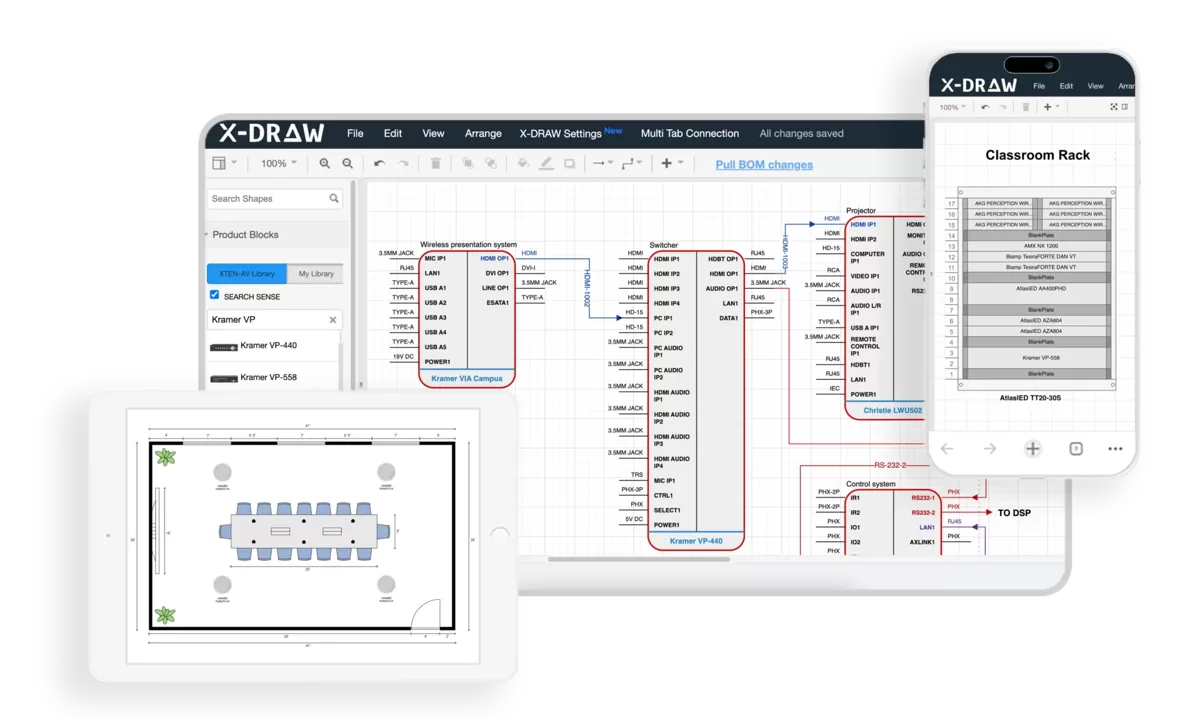
X-Draw combines comprehensive CAD functionality with AV-specific tools, enabling integrators to create precise floor plans, equipment layouts, acoustic treatment designs, and signal flow diagrams within a unified platform. The software integrates extensive manufacturer databases including speakers, displays, processors, and control systems, complete with real-time pricing and technical specifications, making it invaluable throughout design, specification, and estimation phases.
Key Features
Design Tools:
Drag-and-drop equipment library with 18,000+ manufacturer-certified components
Acoustic treatment placement tools with absorption/diffusion calculators
Viewing angle calculators ensuring optimal display sizing and seating layout
Speaker coverage patterns visualizing sound dispersion
3D room visualization with realistic material rendering
Lighting design integration planning dimmable fixtures and control
Documentation:
Automated cable calculations with length estimates and specifications
Signal flow diagrams with automatic wire labeling
Rack elevation drawings showing equipment mounting
Bill of materials with real-time distributor pricing
Professional client presentations with branded templates
Installation guides for field technicians
Collaboration:
Cloud storage enabling multi-designer projects
Version control tracking design iterations
Comment threads facilitating stakeholder feedback
Client portal for approval workflows
Export compatibility (AutoCAD, PDF, Excel, PNG)
Integration:
Manufacturer databases updated quarterly
Pricing engines from major distributors (Almo, ADI, Snap AV)
Control system programming templates (Control4, Crestron)
Project management platform connections
Pros
✅ Industry-leading AV equipment database reducing research time by 70%
✅ Acoustic modeling tools specifically designed for home theaters
✅ Accurate material estimates improving project profitability 15-20%
✅ Professional documentation enhancing client confidence and closing rates
✅ Regular updates with new products and capabilities quarterly
✅ Excellent support including training webinars and responsive technical help
✅ Integration with popular control system platforms
✅ Mobile app for field reference and measurements
Cons
❌ Learning curve requires 20-40 hours for proficiency
❌ Premium pricing at $3,200/year for professional license
❌ Subscription-only model (no perpetual licenses available)
❌ Resource-intensive requiring modern computers for smooth operation
Best For
XTEN-AV X-Draw excels for:
Professional AV integrators specializing in residential theaters
Custom installers managing multiple concurrent projects
Design-build firms requiring client presentation tools
Consultants creating detailed specification packages
Dealers needing accurate material takeoffs and pricing
Pricing: Professional tier: $3,200/year per license | Enterprise tier with multi-user: $2,800/year per seat (5+ licenses)

Alternative Home Theater Design Software
Chief Architect
Comprehensive home design platform with AV capabilities:
Strengths:
Full architectural design tools for new construction
Extensive material library for finishes and furnishings
3D rendering with photorealistic output
Lighting design integration
Limitations:
Limited AV-specific tools compared to dedicated software
Requires AV equipment libraries to be custom-built
No acoustic modeling built-in
Best for: New construction home theater projects integrated with whole-home design
SketchUp Pro with AV Extensions
Popular 3D modeling with custom home theater components:
Strengths:
Intuitive interface with shallow learning curve
Large user community sharing theater models
Affordable pricing for small integrators
Quick concept development for client meetings
Limitations:
Manual component creation required for most AV equipment
No automated calculations for cables, coverage, acoustics
Limited documentation output for installation
Best for: Concept visualization and preliminary layout development
Room EQ Wizard (REW)
Free acoustic analysis and measurement software:
Strengths:
Comprehensive measurement suite for audio analysis
Room mode calculator predicting bass issues
Waterfall plots, RT60 measurements, frequency response
Subwoofer optimization tools
Limitations:
No visual design or layout capabilities
Steep learning curve for acoustic analysis
Requires calibrated measurement microphone ($75-$300)
Best for: Acoustic analysis and audio calibration supplementing design software
AutoCAD with Custom Theater Blocks
Industry-standard CAD with custom AV libraries:
Strengths:
Professional documentation accepted by architects and contractors
Precise drafting tools for construction drawings
Extensive file compatibility
Custom block libraries for equipment symbols
Limitations:
No AV-specific features built-in
Time-intensive manual drafting process
Requires CAD expertise for effective use
High cost for full-featured version
Best for: Integration with architectural plans and construction coordination
Frequently Asked Questions
Q: What is the minimum budget for a quality home theater?
A: Entry-level dedicated theaters start at $25,000-$35,000 including basic projection system, 7.1.4 audio, acoustic treatment, and professional installation. High-performance systems range $60,000-$150,000+, while reference-grade installations exceed $200,000.
Q: Should I choose a projector or large-format TV for my home theater?
A: Projectors excel for dedicated theaters with light control, offering scalable screen sizes (120"-200"+) and immersive experiences. Large TVs work better for multi-purpose rooms with ambient light, offering simpler installation and no maintenance. For screens over 100", projection typically provides better value.
Q: How many height speakers do I need for Dolby Atmos?
A: Minimum four height speakers (.4) provides entry-level immersive audio. Six height speakers (.6) offers ideal balance of performance and complexity for most installations. Eight or more (.8+) suits reference theaters and larger rooms, providing exceptional three-dimensional sound envelopment.
Q: Is professional calibration worth the cost?
A: Absolutely—professional video and audio calibration transforms equipment performance, often revealing 40-60% improvement over factory settings. Cost ranges $500-$2,000 depending on system complexity, representing 2-5% of total budget while dramatically enhancing the viewing experience.
Q: What room dimensions work best for home theaters?
A: Avoid perfect squares and cubes which create severe acoustic problems. Target ratios of 1.0 (height) : 1.6 (width) : 2.3 (length) or similar non-integer relationships. Minimum room size: 12'x16'x9' (ceiling height). Ideal: 16'x24'x10' or larger for reference-quality performance.
Q: Can I build a home theater in an existing room without major construction?
A: Yes—surface-mounted acoustic treatment, strategic speaker placement, quality equipment, and professional calibration create excellent results without structural modifications. Budget $15,000-$40,000 for equipment and acoustic products. Dedicated construction delivers optimal performance but isn't mandatory for satisfying experiences.
Q: How important is room acoustics compared to equipment quality?
A: Room acoustics often impact performance more than equipment selection. Premium speakers in untreated rooms underperform modest speakers in acoustically optimized spaces. Allocate 15-20% of total budget to acoustic treatment for balanced results. Address acoustics before purchasing top-tier equipment for maximum return.
Conclusion
Designing exceptional home theaters in 2026 demands strategic integration of cutting-edge Audio Visual (a/v) equipment, thoughtful acoustic optimization, and user-centered automation—all balanced within realistic budgets and aesthetic goals. The importance of choosing the best Audio Visual (a/v) equipment extends beyond specifications and brand names; it requires understanding how display technology, audio systems, source devices, and control platforms work together as cohesive ecosystems delivering truly immersive entertainment experiences.
For AV integrators and system designers, success hinges on several critical factors: proper viewing distance calculations ensuring displays create appropriate field of view, multi-subwoofer strategies delivering uniform bass response across all seating, comprehensive acoustic treatment controlling reflections while preserving spaciousness, and HDMI 2.1 infrastructure supporting current and emerging video formats.
AI-powered calibration tools, object-based audio formats, and cloud-based control platforms are transforming how home theaters operate, enabling automated optimization and simplified operation that maximize client satisfaction while reducing service requirements. Professional AV design software—particularly specialized platforms like XTEN-AV X-Draw—streamlines planning, prevents costly installation errors, and ensures optimal equipment placement based on acoustic principles rather than convenience.
The home theater market continues expanding as streaming services deliver cinema-quality content, gaming demands high-performance displays, and flexible entertainment spaces serve multiple roles within modern homes. Integrators who prioritize audio quality over video resolution, implement proper acoustic fundamentals, leverage design software for accurate planning, and partner with manufacturers offering reliable support position themselves for sustained success.
Whether designing compact media rooms or luxurious dedicated cinemas, the principles remain constant: understand room acoustics, select integrated equipment ecosystems, prioritize user experience, plan for scalability, and deliver professional installation with comprehensive documentation. The result is home theater environments that transcend simple TV watching—creating immersive experiences that bring families together, showcase technological excellence, and provide clients with entertainment venues rivaling commercial establishments while offering the comfort, convenience, and personalization only possible in private residences.