Best Audio Visual Room Setup Ideas for Small Spaces and Apartments
Creating an exceptional audio visual (AV) room in compact spaces requires strategic planning that maximizes performance while minimizing footprint. Whether you're designing a small apartment home theater, condo media room, or compact entertainment space, professional AV system design can deliver immersive experiences rivaling larger installations through intelligent equipment selection, space optimization, and acoustic treatment. The challenge isn't space limitation—it's understanding how to leverage compact AV solutions that deliver outstanding audio quality and visual performance within constrained room dimensions.
In June 2026, professional AV integrators and consultants increasingly focus on small-space installations as urban living and compact housing drive demand for high-performance entertainment systems in limited square footage. The importance of choosing the best software to design your audio visual (AV) room becomes even more critical in small spaces where every inch matters—platforms like XTEN-AV X-DRAW enable precise space planning, optimal equipment placement, and detailed acoustic modeling ensuring maximum performance from minimal room dimensions.
This comprehensive guide explores proven AV room setup ideas specifically engineered for small spaces and apartments, covering space-efficient layouts, compact equipment selections, acoustic optimization strategies, and installation techniques that transform constrained environments into exceptional entertainment spaces.
Key Takeaways
✅ Prioritize Multi-Functional Design: Small-space AV rooms must balance entertainment performance with daily living requirements through flexible furniture and convertible layouts
✅ Optimize Vertical Space: Leverage wall mounting, ceiling speakers, and vertical storage maximizing floor space in compact environments
✅ Choose Space-Efficient Equipment: Select compact soundbars, in-wall speakers, flat-panel displays, and wireless systems reducing physical footprint without compromising performance
✅ Invest in Acoustic Treatment: Small rooms benefit dramatically from strategic acoustic panels and bass traps controlling problematic reflections and room modes
✅ Embrace Wireless Technology: Wireless speakers, streaming devices, and Bluetooth connectivity eliminate cable clutter in visually constrained spaces
✅ Plan Strategic Lighting: Ambient lighting control and bias lighting dramatically improve viewing experience without requiring dedicated blackout systems
✅ Use Professional Design Tools: Platforms like XTEN-AV X-DRAW optimize small-space layouts through precise equipment positioning and acoustic modeling
✅ Consider Neighborhood Impact: Apartment installations require sound isolation strategies preventing disturbances to adjacent units
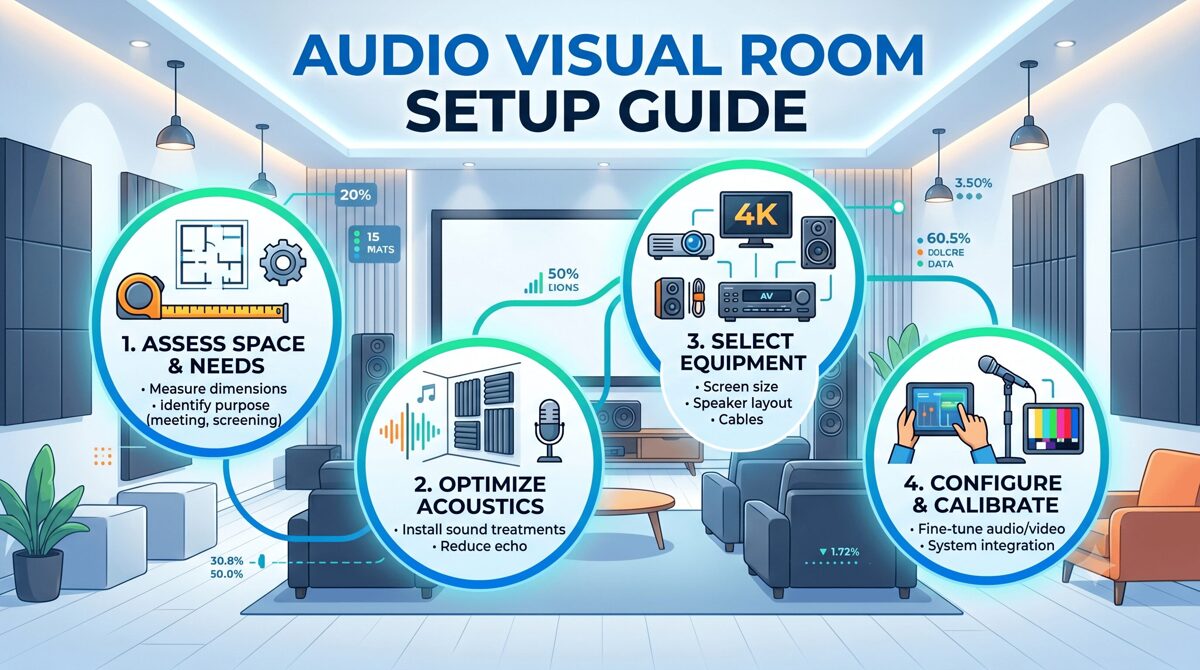
What Is an Audio Visual Room Setup?
An audio visual room setup represents the integrated installation of display technology, audio systems, source equipment, and control interfaces within a dedicated or multi-purpose space optimized for entertainment, gaming, presentation, or content consumption.
Core Elements of AV Room Installations
Display Systems: Flat-panel TVs, OLED displays, projection systems, or LED screens properly sized and positioned for optimal viewing geometry within available wall space
Audio Infrastructure: Speaker systems, soundbars, subwoofers, amplifiers, and acoustic treatments calibrated for room dimensions and listening positions
Source Devices: Streaming media players, gaming consoles, Blu-ray players, cable/satellite boxes, and media servers providing content to display and audio systems
Control Systems: Universal remotes, smart home integration, voice control, or touchscreen interfaces simplifying system operation
Infrastructure: HDMI cables, power management, network connectivity, and cable management ensuring reliable system performance and clean aesthetics
Room Optimization: Acoustic treatment, lighting control, furniture arrangement, and equipment placement maximizing performance within space constraints
Small-Space AV Room Categories
Studio Apartment Theaters: Single-room spaces requiring multipurpose design balancing entertainment, work, and living functions
Bedroom Entertainment Systems: Secondary viewing spaces in bedrooms optimized for comfortable casual viewing and late-night entertainment
Compact Living Room Theaters: Primary entertainment spaces in small apartments or condos serving as main family rooms
Den/Office Media Rooms: Dual-purpose spaces combining home office functionality with entertainment capabilities
Loft Entertainment Zones: Open-concept living areas requiring acoustic management and strategic equipment placement in non-traditional room configurations
Each category demands customized approaches addressing specific space limitations, acoustic challenges, and multi-functional requirements.
Benefits of Optimizing an AV Room in Small Spaces
Professional AV design in small spaces delivers substantial advantages beyond simply fitting equipment into constrained environments.
Enhanced Performance Through Precision
Controlled Acoustic Environment: Small rooms naturally provide more controlled acoustic spaces where proper treatment and speaker placement achieve exceptional sound quality
Intimate Viewing Experience: Closer viewing distances in compact spaces enable smaller, more affordable displays while maintaining immersive cinema-like experiences
Reduced Equipment Requirements: Small room volumes require less amplifier power and fewer speakers achieving target sound pressure levels, reducing equipment costs
Simplified Calibration: Limited room dimensions simplify acoustic calibration and room correction processes with more predictable acoustic behavior
Space Efficiency and Multi-Functionality
Maximized Living Space: Strategic AV integration preserves valuable floor space for daily living through wall-mounting, wireless technology, and compact equipment
Flexible Room Usage: Well-designed small-space AV systems enable rooms to transition seamlessly between entertainment, work, exercise, or relaxation functions
Hidden Technology: In-wall speakers, concealed equipment, and integrated design maintain clean aesthetics without sacrificing performance
Furniture Integration: Entertainment centers, media cabinets, and custom furniture incorporate AV equipment without dominating limited room space
Cost Optimization
Lower Equipment Investment: Small spaces require fewer speakers, less powerful amplification, and smaller displays, reducing overall system costs
Reduced Installation Complexity: Shorter cable runs and simplified wiring reduce installation labor compared to larger spaces
Energy Efficiency: Compact AV systems consume less power for equivalent performance levels reducing operational costs
Acoustic Treatment ROI: Small room treatment requires fewer acoustic panels and materials delivering greater performance improvement per dollar invested
Urban Living Advantages
Rental-Friendly Solutions: Non-permanent installations using tension-mounted speakers and temporary treatments enable high-performance systems without property modifications
Noise Management: Properly designed apartment AV systems incorporate sound isolation preventing neighbor disturbances and complaints
Smart Home Integration: Compact spaces naturally suit smart home technology enabling voice control and automation enhancing convenience
Future-Proof Flexibility: Modular designs and wireless technology enable easy system relocation when moving between rental properties
Strategic planning addressing small-space constraints ensures successful AV installations maximizing performance within limitations.
Room Dimensions and Geometry
Measure Accurately: Document exact room dimensions including ceiling heights, door swings, window locations, and architectural features
Identify Obstacles: Note electrical outlets, HVAC vents, light fixtures, and structural elements affecting equipment placement
Evaluate Proportions: Assess room ratios identifying potential acoustic problems from problematic dimensions (square rooms, identical dimensions)
Consider Ceiling Height: Low ceilings (under 8 feet) limit overhead speaker options while high ceilings may require acoustic treatment on vertical surfaces
Acoustic Challenges in Small Spaces
Room Modes: Small dimensions create strong standing waves at specific frequencies requiring strategic bass management
Flutter Echo: Parallel walls in small rooms generate problematic flutter echoes necessitating acoustic absorption or diffusion
Boundary Reinforcement: Proximity to walls and corners dramatically affects bass response requiring careful subwoofer positioning
Reflection Management: Limited space means primary reflections from room boundaries arrive quickly, demanding strategic treatment
Structural and Building Considerations
Shared Walls: Apartment installations must consider sound transmission to adjacent units requiring isolation strategies
Floor Construction: Upper-floor apartments need bass management preventing low-frequency transmission to units below
Building Restrictions: Review lease agreements or HOA rules regarding wall mounting, permanent installations, and noise regulations
Electrical Capacity: Assess available electrical outlets and circuit capacity supporting AV equipment without overloading
Multi-Functional Requirements
Primary Usage Patterns: Determine if space serves primarily for entertainment, work, exercise, or balanced multi-purpose usage
Daytime Functionality: Consider how AV equipment integrates with daytime activities when not actively used for entertainment
Storage Requirements: Plan for media storage, game collections, equipment accessories, and remote controls without cluttering limited space
Furniture Flexibility: Evaluate whether fixed theater seating or movable furniture better suits lifestyle and space constraints
Technology Infrastructure
Network Connectivity: Assess Wi-Fi coverage, ethernet availability, and internet bandwidth supporting streaming and smart devices
Power Distribution: Plan adequate electrical outlets near equipment locations avoiding excessive extension cords
Cable Management: Develop strategy for concealing HDMI cables, speaker wires, and power cords in visually exposed spaces
Smart Home Integration: Consider compatibility with existing smart home platforms (Alexa, Google Home, HomeKit)
Budget Allocation for Small Spaces
Equipment Prioritization: Allocate budget emphasizing audio quality and acoustic treatment over oversized displays
Installation Flexibility: Balance DIY installation versus professional services based on technical capability and complexity
Future Expandability: Plan for potential system upgrades or room changes when moving or expanding living space
Acoustic Investment: Dedicate 15-20% of budget to acoustic treatment delivering disproportionate performance improvement in small rooms
7 Best Audio Visual Room Setup Ideas for Small Spaces and Apartments
These proven layout strategies maximize AV performance while preserving livability in constrained environments.
1. Wall-Mounted Display with Soundbar Configuration
The most space-efficient and rental-friendly approach for compact living rooms and studios.
Layout Strategy:
Wall-mounted TV (55"-65") at optimal viewing height (eye level when seated)
Premium soundbar with wireless subwoofer mounted below display or on media console
Streaming devices hidden behind TV or in media cabinet
Minimal furniture footprint with clean cable management
Advantages: ✅ Maximum floor space preservation ✅ Rental-friendly installation using removable mounts ✅ Excellent audio upgrade over TV speakers without complex installation ✅ Clean aesthetics with minimal visible equipment ✅ Simple system operation suitable for all users
Optimal For:
Studio apartments and compact living rooms under 150 sq ft
Renter-occupied spaces requiring non-permanent solutions
Budgets under $2,000-$3,000 for complete system
Users prioritizing simplicity over reference-grade performance
Key Implementation Tips:
Choose soundbar with Dolby Atmos and upward-firing drivers for immersive audio
Position wireless subwoofer in corner for bass reinforcement
Use bias lighting behind TV reducing eye strain
Mount soundbar on wall below TV rather than on media console for improved sound projection
2. Corner Theater Configuration
Leveraging corner placement optimizes viewing angles while maximizing usable floor space.
Layout Strategy:
TV or projection screen positioned diagonally across corner
Seating arranged in shallow arc facing corner
In-wall or bookshelf speakers flanking display
Subwoofer placed in opposite corner for bass distribution
Acoustic panels on adjacent walls controlling first reflections
Advantages: ✅ Opens center floor space for other activities ✅ Creates defined entertainment zone in open-plan spaces ✅ Diagonal viewing angles work well in narrow rooms ✅ Natural acoustic treatment from adjacent walls ✅ Accommodates awkward room layouts
Optimal For:
Rectangular rooms where conventional wall placement creates poor viewing geometry
Open-plan apartments requiring defined zones
Small bedrooms maximizing floor circulation
Rooms with challenging window or door placements
Key Implementation Tips:
Use corner floating shelves for equipment storage
Install corner bass traps managing low-frequency buildup
Angle speakers toward primary listening position
Consider swivel TV mount enabling viewing from multiple seating positions
3. Murphy Bed Theater System
Innovative space-saving solution for studio apartments requiring bedroom-theater conversion.
Layout Strategy:
Wall-mounted display that remains accessible when Murphy bed is deployed
In-ceiling speakers or height-mounted speakers unaffected by bed position
Compact soundbar or sound base positioned to function in both configurations
Equipment rack in closet or wall cabinet
Advantages: ✅ True dual-purpose space serving as bedroom and theater ✅ Maintains entertainment functionality 24/7 regardless of bed position ✅ Maximizes extremely limited space in micro-apartments ✅ Clean aesthetics with hidden equipment
Optimal For:
Studio apartments under 400 sq ft requiring bedroom conversion
Guest rooms serving occasional sleeping quarters
Micro-living spaces demanding maximum flexibility
Spaces where sleeping and entertainment occur in same area
Key Implementation Tips:
Mount TV high enough to view comfortably from bed
Use in-ceiling speakers avoiding obstruction when bed deploys
Install equipment in adjacent closet preventing bed interference
Consider wireless speakers eliminating floor-level cable conflicts
4. Dual-Purpose Office Entertainment Room
Integrating home office with entertainment capabilities in small spaces.
Layout Strategy:
Large display (32"-43") serving as computer monitor and entertainment screen
Desk positioning enabling comfortable viewing from work chair and entertainment seating
Compact bookshelf speakers on desk doubling for music and content
Acoustic panels improving both video conferencing and entertainment audio
Cable management supporting both work and entertainment connectivity
Advantages: ✅ Maximizes utility from single display investment ✅ Acoustic treatment improves video conferencing quality ✅ Equipment consolidation reducing overall footprint ✅ Suitable for remote workers needing entertainment options
Optimal For:
Home offices in small apartments or spare bedrooms
Remote workers desiring entertainment integration
Den or study spaces serving multiple functions
Rooms where work-from-home demands compete with entertainment needs
Key Implementation Tips:
Use monitor arms enabling display repositioning for different viewing modes
Select powered speakers with multiple inputs (computer, TV, gaming)
Install task lighting that dims for entertainment viewing
Consider ergonomic furniture comfortable for extended work and entertainment sessions
5. In-Wall Speaker System with Minimal Footprint
Premium audio performance with virtually invisible equipment footprint.
Layout Strategy:
In-wall speakers for front left, center, right channels
In-ceiling speakers for surround channels or height effects
In-wall subwoofer or compact powered subwoofer
Wall-mounted TV with recessed equipment niche
Acoustic fabric panels concealing speakers in decorative frames
Advantages: ✅ Zero floor space consumption by speakers ✅ Superior audio performance versus soundbars ✅ Clean aesthetics with virtually invisible technology ✅ Multi-channel surround sound in minimal space ✅ Permanent installation increasing property value
Optimal For:
Homeowners able to make permanent modifications
Luxury apartments where high-end finish justifies investment
Media rooms prioritizing performance over portability
Users desiring reference-quality audio in compact space
Key Implementation Tips:
Hire professional installer ensuring proper speaker positioning and wall reinforcement
Use in-wall speakers with back boxes isolating sound transmission
Position in-wall subwoofer carefully managing bass coupling with walls
Install access panels enabling future equipment service
Important Note: This approach requires property ownership or landlord approval for wall modifications.
6. Projector-Based Compact Theater
Projection systems can work exceptionally well in small spaces with proper planning.
Layout Strategy:
Short-throw projector minimizing throw distance requirements
Retractable screen or painted wall preserving space when not in use
Compact 5.1 or 3.1 speaker system with in-ceiling or on-wall speakers
Blackout shades or curtains controlling ambient light
Projector ceiling-mounted or on rear wall shelf
Advantages: ✅ Larger screen sizes (80"-100") than affordable flat-panels ✅ Retractable screens enable multi-purpose space usage ✅ More cinematic experience in limited space ✅ Short-throw projectors work in rooms as small as 8-10 feet ✅ Lower cost per inch versus large flat-panel displays
Optimal For:
Small dedicated theaters with adequate light control
Living rooms where screen can retract exposing artwork or windows
Basements or windowless rooms under 150 sq ft
Movie enthusiasts prioritizing screen size over 4K resolution
Key Implementation Tips:
Select short-throw or ultra-short-throw projector reducing installation distance
Use ambient light rejecting (ALR) screens if perfect light control impossible
Install acoustic panels on ceiling preventing projector fan noise reflection
Consider laser projectors eliminating lamp replacement maintenance
7. Vertical Space Optimization with Height Channels
Leveraging ceiling space for audio channels in small floor-plan rooms.
Layout Strategy:
Dolby Atmos-enabled speakers or upward-firing modules creating height channels
Compact floor-standing or bookshelf speakers for front channels
In-ceiling speakers for surround and height effects
Vertical equipment rack or wall-mounted shelving for components
Wall-mounted TV maintaining open floor space
Advantages: ✅ Immersive 3D audio without expanding floor footprint ✅ Height channels create spaciousness perception in small rooms ✅ Ceiling speakers avoid furniture placement conflicts ✅ Modern Dolby Atmos content delivers exceptional experience
Optimal For:
Small rooms where floor space is premium but ceiling access available
Home theater enthusiasts desiring immersive object-based audio
Rectangular rooms where ceiling reflections support height virtualization
Standard ceiling heights (8-9 feet) enabling effective overhead sound
Key Implementation Tips:
Use Dolby Atmos-enabled speakers if ceiling mounting impractical
Position height speakers 45-60 degrees from listening position
Combine height channels with quality bass management
Calibrate using Dolby Atmos test content ensuring proper overhead localization
Best AV Equipment for Small Rooms and Apartments
Selecting appropriate equipment optimized for compact spaces ensures maximum performance without wasting budget on oversized components.
Display Technology for Small Spaces
Optimal TV Sizes by Room Dimensions:
Rooms under 100 sq ft: 43"-50" displays
100-150 sq ft: 50"-55" displays
150-200 sq ft: 55"-65" displays
200-250 sq ft: 65"-75" displays
Display Technology Recommendations:
OLED TVs: Superior contrast and black levels for dark room viewing
QLED TVs: Better brightness for rooms with ambient light
Mini-LED TVs: Excellent HDR performance at mid-range pricing
Short-throw projectors: 80"-100" screens in rooms under 10 feet deep
Audio Solutions for Compact Environments
Premium Soundbars (Under $1,000)
Sonos Arc: Excellent Dolby Atmos with room correction and streaming integration
Samsung HW-Q990C: Wireless surround speakers and powerful subwoofer included
Sony HT-A7000: Exceptional spatial audio with upward-firing drivers
Advantages: Simple installation, wireless connectivity, excellent dialogue clarity
Limitations: Cannot match dedicated speaker systems for critical listening
Compact Speaker Systems ($1,000-$3,000)
KEF LSX II: Wireless powered speakers with exceptional sound quality and compact size
ELAC Debut 2.0: Budget-friendly bookshelf speakers delivering outstanding value
Q Acoustics 3020i: Compact bookshelf speakers with refined sound in small enclosures
SVS Prime Satellite 5.1: Complete surround system with tiny satellite speakers
Advantages: Superior audio quality, upgrade flexibility, traditional hi-fi performance
Limitations: Requires AV receiver or amplifier, more complex setup
Subwoofers for Small Spaces
SVS SB-1000 Pro: Compact sealed subwoofer with excellent bass control and app integration
REL Acoustics T/5x: Designed specifically for small rooms with refined bass response
Polk Audio HTS 10: Budget-friendly 10-inch subwoofer adequate for compact spaces
Key Selection Criteria:
Sealed enclosures provide tighter bass better suited to small rooms
DSP-equipped subwoofers enable room correction controlling bass modes
Smaller drivers (8"-10") often outperform larger subs in confined spaces
Streaming and Source Equipment
Apple TV 4K: Premium streaming with excellent interface and smart home integration
NVIDIA Shield TV Pro: Powerful streaming with gaming capabilities and Plex server functionality
Xbox Series S: Compact gaming console doubling as 4K streaming device and Blu-ray player
Roku Ultra: Budget-friendly streaming with comprehensive app support
Control and Automation
Logitech Harmony Elite: Universal remote control simplifying multi-device operation
Smart Home Integration: Alexa, Google Home, or HomeKit enabling voice control
Savant or Control4: Professional automation systems for luxury installations
How Professional Design Software Optimizes Small-Space AV Installations
Creating effective small-space AV designs requires precision impossible through casual planning—specialized design software ensures optimal results.
XTEN-AV X-DRAW: Small-Space Design Optimization
Professional AV design software becomes especially valuable in compact spaces where every inch matters and equipment placement must be exact.
Why X-DRAW Excels for Small-Space Projects:
Precise Space Planning: X-DRAW enables exact equipment placement within constrained floor plans, ensuring proper viewing distances, speaker positioning, and furniture clearances in limited square footage
Acoustic Modeling Tools: Visualize speaker coverage patterns and acoustic treatments specific to small room dimensions, identifying problematic reflection points and optimal treatment locations
Equipment Database: Access compact and space-efficient AV equipment specifically suited to small installations, eliminating oversized components wasting precious space
3D Visualization: Generate realistic 3D renderings showing exactly how AV equipment integrates with small-space furniture and décor before purchasing
Cable Planning Optimization: Plan shortest possible cable runs in compact spaces, minimizing visible wiring and installation complexity
Multi-Configuration Layouts: Explore multiple layout alternatives comparing different equipment placements and furniture arrangements finding optimal space utilization
BOM Accuracy: Generate precise equipment lists preventing over-purchasing or wrong component selection for space constraints
Client Visualization: Share 3D designs with clients helping them understand how AV systems will function in their specific small spaces
X-DRAW's AI-assisted workflows analyze room dimensions recommending optimal equipment placement and identifying potential acoustic problems before installation—invaluable for small spaces where correction opportunities are limited.

Audio Visual Room Layout Mistakes to Avoid
Learning from common small-space planning errors prevents expensive corrections and performance compromises.
Equipment Selection Mistakes
❌ Oversized Displays: Purchasing TVs too large for viewing distance causing eye strain and compromised image quality
❌ Undersized Subwoofers: Selecting inadequate bass reproduction failing to deliver immersive low-frequency effects
❌ Wrong Speaker Types: Using floor-standing speakers consuming excessive floor space when bookshelf or in-wall options deliver equivalent performance
❌ Excessive Equipment: Over-specifying amplifier power or speaker quantities wasting budget without performance improvement
Layout and Placement Errors
❌ Poor Viewing Geometry: Positioning displays at wrong heights or angles creating uncomfortable viewing positions
❌ Blocking Traffic Paths: Equipment placement obstructing walkways or door swings in small spaces
❌ Corner Bass Loading: Placing subwoofers in corners amplifying room modes creating boomy, uncontrolled bass
❌ Symmetry Obsession: Forcing symmetrical speaker placement despite room asymmetry compromising acoustic performance
Acoustic Treatment Mistakes
❌ No Treatment: Ignoring acoustic treatment allowing flutter echo and room modes to degrade audio quality
❌ Over-Treatment: Excessive absorption creating dead, lifeless sound lacking natural ambience
❌ Wrong Treatment Placement: Positioning acoustic panels randomly rather than targeting first reflection points
❌ Foam Only: Using only thin foam instead of proper broadband absorbers and bass traps
Infrastructure and Installation Errors
❌ Inadequate Power: Overloading electrical circuits with AV equipment causing breaker trips
❌ Visible Cable Chaos: Poor cable management creating visual clutter ruining aesthetics
❌ No Network Planning: Inadequate Wi-Fi coverage or bandwidth causing streaming interruptions
❌ Permanent Modifications: Making irreversible changes in rental properties without landlord approval
Multi-Functional Space Mistakes
❌ Fixed Seating: Installing permanent theater seating eliminating room flexibility
❌ Single-Purpose Design: Creating dedicated theaters at expense of daily living functionality
❌ No Daytime Planning: Designing only for entertainment ignoring how space functions during day
❌ Storage Neglect: Failing to plan equipment storage, game collection, and accessory organization
Frequently Asked Questions
Q: What is the ideal TV size for a small apartment living room?
A: TV sizing depends on viewing distance rather than room size. For small apartments, measure distance from seating position to TV location. Optimal screen size follows: viewing distance (inches) ÷ 1.5 = recommended diagonal screen size for 4K displays. For example, 7-foot (84 inches) viewing distance suggests 56-inch display (84 ÷ 1.5). Most small living rooms with 6-8 foot viewing distances suit 50"-65" displays. Larger screens at close distances create immersive experiences but require turning head to see screen edges. Smaller screens at same distance feel less engaging. Consider OLED technology for small rooms where viewers sit relatively close—superior pixel-level contrast reveals more detail at closer viewing distances than LED TVs.
Q: Can I get good surround sound in a small apartment without disturbing neighbors?
A: Yes, excellent surround sound is achievable in apartments with proper volume management and bass control. Use sealed subwoofers rather than ported designs—sealed enclosures provide tighter bass with less low-frequency transmission through walls and floors. Enable night mode or dynamic range compression on AV receiver reducing loud explosions and effects while maintaining dialogue clarity. Install bass shakers in seating delivering tactile low-frequency effects without audible bass traveling to adjacent units. Use acoustic panels on shared walls absorbing sound before transmission. Set subwoofer crossover at 60-70Hz rather than typical 80Hz, reducing problematic low frequencies. Consider headphone systems with surround processing for late-night viewing. Modern Dolby Atmos soundbars deliver impressive spatial audio at moderate volumes suitable for apartment living.
Q: What's the most cost-effective way to improve audio in a small room?
A: Strategic acoustic treatment delivers the greatest performance improvement per dollar invested in small rooms. Install acoustic panels at first reflection points on side walls (where sound from front speakers first bounces before reaching ears). Add bass traps in room corners controlling problematic low-frequency modes common in small spaces. Use thick curtains on windows reducing glass reflections. Position furniture and bookshelves breaking up parallel wall surfaces creating natural diffusion. This acoustic optimization costs $300-$600 but improves perceived audio quality more than upgrading from $500 to $2,000 speakers in untreated rooms. After room treatment, upgrade to quality bookshelf speakers ($300-$600 pair) and proper subwoofer ($400-$600) delivering dramatic improvement over soundbars at similar total investment. Budget 20% of AV budget to acoustic treatment for maximum cost-effectiveness.
Q: Should I mount my TV or use a media console in a small space?
A: Wall mounting typically proves superior for small spaces unless rental restrictions or wiring challenges make it impractical. Wall mounting advantages include: maximizes floor space allowing furniture flexibility, positions display at optimal viewing height independently of furniture height, enables smaller furniture or eliminates media console entirely saving space, creates cleaner aesthetics with concealed cables using in-wall routing or cord covers, and enables easier cleaning and floor maintenance. However, media consoles offer advantages: provides storage for gaming consoles, streaming devices, and media collections, requires no wall modifications in rental properties, simplifies equipment access for connections and troubleshooting, and accommodates soundbar placement without separate wall mounting. Best approach: wall-mount TV with slim floating shelf below for equipment—combines space efficiency with practical component access.
Q: How much should I budget for a complete small-space AV system?
A: Budget ranges for small-space AV systems vary by performance expectations: Entry-level ($1,500-$3,000): 50"-55" quality OLED TV, premium soundbar with wireless subwoofer, streaming device, and basic acoustic treatment. Mid-range ($3,000-$6,000): 55"-65" OLED TV, 5.1 speaker system with quality bookshelf speakers and subwoofer, AV receiver with Dolby Atmos, streaming devices, and comprehensive acoustic treatment. Premium ($6,000-$12,000): 65"-75" high-end OLED, reference-quality speakers with multiple subwoofers, premium AV processor and amplification, smart home integration, professional acoustic design and treatment, and custom installation. Allocate budget: 40-45% display, 35-40% audio (speakers, subwoofer, receiver), 10-15% acoustic treatment and installation materials, 5-10% sources and control. Small-space systems often cost less than equivalent large-room installations due to smaller displays and fewer speakers required, but invest savings in acoustic treatment and higher-quality components maximizing performance within space constraints.
Q: What acoustic treatment works best for small apartment theaters?
A: Small-room acoustic treatment should balance absorption and diffusion without over-deadening space. Essential treatments: Corner bass traps (2-4 units) in ceiling-wall corners controlling low-frequency room modes common in small spaces, first reflection panels (4-6 panels) on side walls at mirror points between front speakers and listening position, absorption panels (2-4 panels) behind listening position reducing rear-wall reflections, and ceiling cloud (optional) above listening position if ceiling reflections problematic. Use thick (4"-6") broadband absorbers rather than thin foam providing effective absorption across wider frequency range. For apartments, avoid heavy wall modifications—use freestanding bass traps and wall panels with command strips or frame mounting enabling removal. Acoustic fabric panels integrate visually as artwork. Budget approximately $500-$800 for DIY acoustic treatment or $1,200-$2,000 for professional products and installation. In very small rooms (under 120 sq ft), focus primarily on bass control and first reflection treatment—avoid excessive treatment creating unnatural dead sound.
Q: How does AI-powered design software help with small AV room planning?
A: AI-powered design platforms like XTEN-AV X-DRAW dramatically improve small-space planning through intelligent analysis and recommendations. AI capabilities include: analyzing room dimensions identifying optimal display sizes and viewing distances specific to space, recommending speaker placement maximizing acoustic coverage within footprint constraints, suggesting equipment selections from extensive databases matching space requirements and budget parameters, identifying problematic acoustic reflection points and recommending treatment locations, optimizing cable routing for shortest runs and cleanest installations, generating multiple layout alternatives comparing different approaches enabling informed decisions, and predicting acoustic performance before physical installation. For small spaces, AI analysis prevents common mistakes like oversized equipment, poor speaker positioning, or inadequate acoustic treatment. X-DRAW's AI workflows reduce planning time 40-60% while improving design quality, especially valuable for compact spaces where precision matters and correction opportunities are limited after installation. The technology democratizes professional AV design expertise making it accessible to integrators, consultants, and even sophisticated homeowners planning DIY projects.
Conclusion
Creating exceptional audio visual (AV) room experiences in small spaces and apartments requires strategic planning emphasizing space efficiency, acoustic optimization, and intelligent equipment selection over brute-force solutions applicable only to larger environments. The compact living trend driving urban housing makes small-space AV expertise increasingly valuable for professional integrators, consultants, and system designers serving clients in apartments, condos, and compact homes.
The seven setup ideas presented—from wall-mounted soundbar configurations to vertical space optimization with height channels—demonstrate that small spaces need not compromise entertainment quality. Strategic approaches leveraging multi-functional design, wireless technology, compact equipment, and acoustic treatment deliver immersive experiences rivaling dedicated home theaters in much larger spaces.
Equally critical is choosing the right design tools. Professional platforms like XTEN-AV X-DRAW enable precise space planning, optimal equipment placement, and detailed acoustic modeling ensuring maximum performance from minimal room dimensions. The software's AI-powered capabilities, equipment databases, and 3D visualization transform small-space design from guesswork into science, preventing costly mistakes and ensuring first-time success.
As we progress through June 2026, expect continued innovation in compact AV technology—smaller speakers delivering reference-quality performance, advanced DSP correcting small-room acoustics, 8K displays in smaller form factors, and wireless systems eliminating cable clutter. These advances make current moment the best time ever for creating outstanding entertainment experiences in compact living spaces.
Whether you're a professional integrator designing client systems or planning your own small-apartment theater, the principles, strategies, and equipment recommendations in this guide provide the foundation for exceptional audio visual rooms that deliver impressive performance while preserving precious living space in our increasingly compact world.